Research explained
Your Hearing at 50: The Baseline Test Most People Skip
Speech-frequency hearing loss rose from 14% to 26% in six years in adults 45 to 70. See the risk factors, then book a baseline hearing test.
Read time: 7 min read
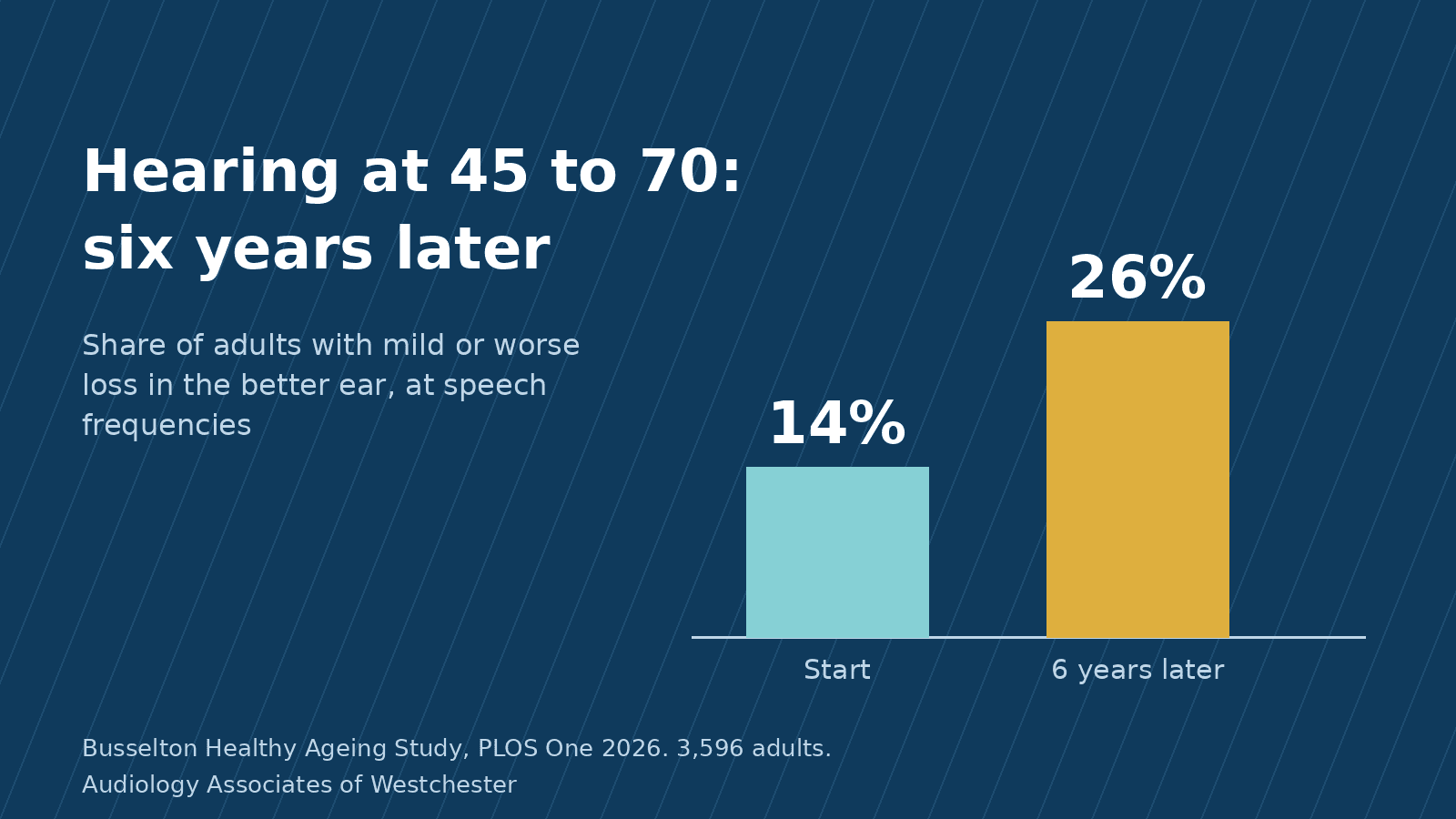
Most people get their eyes checked and their blood pressure measured in midlife. Few get a hearing test. A 2026 study that followed 3,596 adults in Busselton, Western Australia, shows why that gap matters. Over six years, the share with at least mild hearing loss in their better ear, at speech frequencies, rose from about 14 percent to about 26 percent.
This page explains what that study and a second 2026 analysis on diabetes found, what they do not show, which risk factors may move your starting point earlier, and what a baseline hearing evaluation is. Both studies are observational. They show patterns, not proof of cause, and neither tested whether an early hearing test changes outcomes.
“You check your eyes and your blood pressure in midlife. A baseline hearing test is the same idea: one measured starting point to compare against later.”
What the six-year study found
The Busselton Healthy Ageing Study (Smit and colleagues, PLOS One, 2026) tested adults aged 45 to 70 and tested them again six years later. Of 3,596 people with reliable results at both visits, the average age at the start was about 58. The share with mild or worse loss in the better ear rose from 14 to 26 percent at speech frequencies (0.5 to 4 kHz) and from 53 to 71 percent at high frequencies (4 and 8 kHz). Hearing worsened in every age group, more in men than in women, and faster at high frequencies than at speech frequencies. This is one group of adults in one Australian town, so it cannot tell you your own numbers.
| Question | Busselton Healthy Ageing Study | Diabetes meta-analysis |
|---|---|---|
| Where published | PLOS One, 2026 | Diabetes/Metabolism Research and Reviews, 2026 |
| Who was studied | 3,596 adults aged 45 to 70 in Busselton, Western Australia, tested twice, six years apart | 29 qualifying studies of adults with diabetes, mostly type 2. 23 studies with 5,221 people gave the prevalence figure |
| Hearing measure | Mild or worse loss in the better ear | Moderate-to-severe loss, 40 dB HL or worse |
| Main result | Speech frequencies: 14 to 26 percent. High frequencies: 53 to 71 percent | About 24 percent had hearing loss (95 percent range 19 to 30). Odds were 2.41 times those without diabetes (11 studies) |
| What it does not show | That testing or treatment changes the course of hearing loss. Risk factors linked to faster decline are associations | That diabetes causes hearing loss, or anything about prediabetes (one study included it). Results varied widely between studies |
Why midlife is the window to pay attention
Hearing usually changes slowly, and the brain adapts, so many people do not notice until conversation gets hard. The Busselton researchers linked faster decline to higher body mass index, smoking, tinnitus, chronic ear infection, a noisy workplace, high blood pressure and pre-diabetes, after adjusting for age and sex. These are associations, not proof. A hearing test in midlife gives you a measured starting point, so a later change is easy to see. Listening also takes more effort as hearing changes. Read about hearing loss and listening fatigue, and about whether hearing loss is normal with age.
Where diabetes fits among the risk factors
A 2026 meta-analysis (Nisar and colleagues, Diabetes/Metabolism Research and Reviews) pooled studies of adults with diabetes. About 24 percent had moderate-to-severe hearing loss, and their odds of hearing loss were 2.41 times those of people without diabetes. The gap was clearest in adults under 60, and it was not statistically clear at 60 and older. Almost all the studies looked at type 2 diabetes, and only one included prediabetes, so these figures should not be read as applying to prediabetes. Results also varied widely from study to study. Researchers believe diabetes may harm the small blood vessels and nerves of the inner ear, but these studies did not prove that. We do not provide diabetes care or diabetes screening. If you have diabetes, a baseline hearing test is one thing to add to your routine, and your own doctor guides the rest.
Other things that can move your baseline earlier
Noise is the risk factor in the Busselton data that you can act on today. The effect was strongest among workers with a noisy workplace who used inconsistent hearing protection or none. See our pages on noise-induced hearing loss prevention and custom earplugs. Tinnitus and chronic ear infections were also linked to faster decline, so ringing in your ears or repeated infections are reasons to book sooner. Our page on tinnitus management explains your options.
The Midlife Hearing Checklist
Book a baseline test if you answer yes to any of these. 1. You ask people to repeat themselves, especially in restaurants or group talk. 2. You turn the TV or phone volume up more than you used to. 3. Phone calls are harder than they were. 4. You feel worn out after a long conversation. 5. You hear ringing or buzzing, in one or both ears. 6. You have diabetes, high blood pressure or a noisy job, or you smoke or used to. A yes does not mean you have hearing loss. It means a measured test is worth having. Print this page to take it to your next checkup. If your hearing drops suddenly in one or both ears, do not wait for an appointment. Get prompt medical care and read about sudden hearing loss.
What a baseline hearing evaluation measures
A baseline evaluation records the quietest sounds you hear at each pitch, which is your audiogram, and how well you understand speech. It also checks for signs that need a physician's attention, and we refer you when they appear. The result is a reference point. If your hearing changes later, we compare it with your own numbers, not with an average. The audiogram chart below shows where the sounds of speech sit. See what happens at the visit on our page about the comprehensive hearing evaluation, and read why your audiogram matters.
How often to retest
No study cited here tested how often adults should repeat a hearing test, so there is no research-based schedule. We set the timing with you after your first results. A normal first test, a loss that is changing, diabetes and a noisy job can each point to a different interval.
What this means for you
You do not need to wait for a problem to learn where your hearing stands. A baseline test in your late 40s or 50s gives you a reference point, and it matters more if diabetes, high blood pressure or noise are part of your picture. The studies on this page cannot say that testing prevents hearing loss. They say that hearing changes in midlife are common and easy to miss. Book a hearing evaluation at our Harrison or Somers office, or call (914) 949-0034. Not ready to book? Leave your email in the box below the questions, and we will write once when new midlife hearing research is worth your time.
Status and last update
Last updated October 20, 2026. Change note: this is the first version. We will revise this page if either paper is corrected, or when new research on midlife hearing is published. Sources are listed at the end of this page.
Medical information notice
This article explains published research for general education. It is not medical advice, and it does not diagnose or treat any condition. We do not provide diabetes care or diabetes screening. Talk with your doctor about your own health. Call (914) 949-0034 to book at our Harrison or Somers office.
Common questions
At what age should I get a hearing test?
No study sets a single age. The Busselton study followed adults aged 45 to 70, and many people are wise to get a baseline in their late 40s or 50s. Test sooner if you have symptoms, diabetes, a noisy job or ringing in your ears. Our page on how often adults should get their hearing checked covers timing.
Is midlife hearing loss reversible?
Loss that starts in the inner ear is usually permanent, and hearing aids can help you hear and understand. Some causes can be treated, such as earwax or fluid behind the eardrum. A hearing test shows which one you have.
Does diabetes cause hearing loss?
The 2026 meta-analysis found hearing loss more often in adults with diabetes, mostly type 2. That is an association, not proof of cause. Researchers believe damage to small blood vessels and nerves in the inner ear may play a part.
I have prediabetes. Should I get tested?
The Busselton study linked pre-diabetes to faster hearing decline, and the meta-analysis had almost no prediabetes data. Both are associations. A baseline test is a low-risk way to know where you stand.
Does insurance cover a baseline hearing test?
It depends on your plan. Our pages on hearing test costs in Westchester and insurance for hearing aids and tests explain what to ask your plan.
Will a baseline test prevent hearing loss?
No. Neither study tested that. A baseline gives you a measured starting point, so later changes are easy to see, and it can lead to earlier help.
Get one email when new midlife hearing research is worth your time.
We will write once when a new study on midlife hearing, or on diabetes and hearing, is worth your attention. We will send nothing else.
Sources and further reading
- Smit et al., Change in hearing loss and its association with general health: the Busselton Healthy Ageing Study. PLOS One 2026. DOI 10.1371/journal.pone.0360651
- Nisar et al., Hearing Loss in Adults With Diabetes and Prediabetes: A Systematic Review and Meta-Analysis. Diabetes/Metabolism Research and Reviews 2026. DOI 10.1002/dmrr.70195
- University of Queensland: hearing loss in people with diabetes (news release, July 2, 2026)
- Medical News Today: 1 in 4 adults with type 2 diabetes experience hearing loss
- Scienmag: hearing loss accelerates in midlife, six-year Australian study reveals