
Audiology Associates of Westchester logo

Phonak EON

A smaller chip, and the AI finally reaches further down the range

Phonak released EON from Stäfa on 24 August 2026 and American dispensers could order it the same afternoon. Three receiver-in-canal models make up the range — Audéo EON Sphere, Audéo EON R, and CROS EON for hearing that has gone on one side only. Our Harrison and Somers audiologists fit all three.

What changed is the processor. Phonak's previous flagship carried two chips, the second existing purely to run a neural network that pulls voices out of surrounding noise. EON does that work on one chip, called HYPERSONIC, and the saving shows up as a shell Phonak puts at 25 per cent smaller and 20 per cent lighter, drawing 37 per cent less current. The consequence that matters to patients is less obvious: because the network is cheaper to run, Phonak has extended it to a third performance level rather than restricting it to the two dearest.

We have read the reference list behind this launch rather than the headline, and the two do not say quite the same thing. Below is what Phonak has demonstrated, what it has asserted, and what nobody yet knows — kept separate, because at four weeks old that distinction is the whole of the useful information.

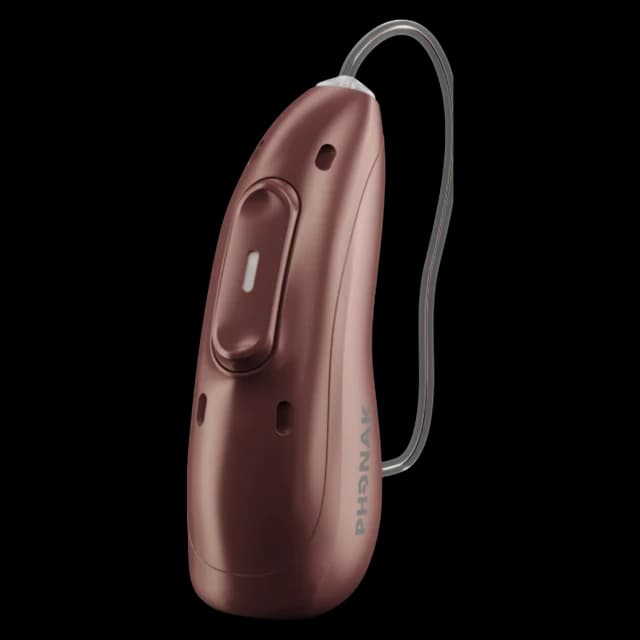
Phonak Audéo EON Sphere rechargeable receiver-in-canal hearing aid in Sienna Red, shown with receiver wire

At a Glance

  • Spheric Speech Clarity 3.0 runs at three performance tiers — 90, 70 and 50 — where the network previously stopped after the top two
  • Auracast broadcast audio is switched on and working, joined by scanning a code in the myPhonak app rather than waiting for a firmware release
  • RogerDirect carries over, so an existing Roger clip, pen, or table microphone pairs straight to the new aids
  • Quoted at up to 38 hours between charges, with a portable case that holds a charge of its own; eight finishes
  • No telecoil on any model, and nothing custom, pediatric, or high-power on the platform — those fittings stay on Infinio and Lumity

Phonak EON Video

The Technology Inside Phonak EON

Follow the Reference, Not the Headline

One sentence is doing most of the work in the coverage of this launch: that wearers are twice as likely to catch every word, whichever direction it comes from. It carries a reference marker, so we followed it. It leads to a Phonak field study published in 2024 — written about the previous platform's version of the same feature — and the comparison it describes is that feature running against the identical aid with the feature disabled. That is a sound finding and we have no quarrel with it. It is simply not a statement about EON, nor about the aid you are wearing today, and if you already own an Infinio Sphere it describes a benefit you have had for two years. The competitive claim, that EON Sphere beat four rival devices for clarity in loud noise, comes from a Phonak-authored paper in 2026 which never identifies the four.

What Phonak Is Careful Not to Claim

Read the launch material closely and an absence stands out. Nowhere does Phonak argue that EON hears more clearly in a noisy room than Infinio Ultra already did. For a company that has spent two years building its reputation on precisely that measure, the restraint is striking, and we read it as honest rather than evasive. It does reshape the upgrade question, though. If you are considering a move from a working Infinio fitting, you are buying a smaller and lighter aid with broadcast audio that functions today — not, on the manufacturer's own account, better hearing in a restaurant.

Auracast That Actually Runs

Broadcast audio is being advertised across the whole industry this year, and much of what is advertised is hardware waiting on a firmware release. Phonak's is live: you point the myPhonak app at a code and the broadcast arrives. Set against that, EON has no telecoil, and neither did the Audéo line before it. Loops remain how most theatres, halls, and houses of worship in Westchester actually transmit, so the practical question is what your particular venue runs. Tell us which one and we will establish it before you commit to a manufacturer — the answer occasionally points somewhere other than Phonak, and we would rather say so.

Eight Finishes, and Why We Raise It

EON is produced in Sienna Red, Sand Beige, Sandalwood, Chestnut, Champagne, Silver Grey, Graphite Gray and Velvet Black. The electronics are identical in every one. We mention it because it is among the few parts of this decision that rest entirely with you, and because it bears on outcome more than a specification sheet suggests: hours worn per day remains the strongest predictor of benefit that anyone has measured, and an aid its owner is content to be seen wearing gets worn. Patients hoping it will disappear against hair or skin tend towards Sand Beige, Sandalwood or Champagne. Those who would rather it read as a piece of equipment than a medical device generally choose Graphite Gray or Velvet Black. Sienna Red is new to this platform and chosen more often than you might expect. We hold the actual finishes against your hair at the fitting rather than asking you to judge from a screen.

What Is Not Available, and What Is Not Yet Known

Every EON is a receiver-in-canal aid. There is no custom in-the-ear shell, no titanium in-the-canal model, no high-power behind-the-ear instrument and nothing for children on this platform; all of those sit on Phonak's older platforms, which remain in the catalogue and in service. No independent laboratory has assessed EON — testing is said to be under way, and on past form the results are months rather than weeks away. Phonak has published no price at any tier, and stated no ingress rating for dust or moisture in the launch documents. Tinnitus goes unmentioned throughout, which is peculiar — Tinnitus Balance has shipped as standard on Audéo aids for a long while. Our expectation is that nothing has changed, but an expectation is not a confirmation, and we will look in the fitting software before putting it in writing.

The Fitting Still Decides the Outcome

There is a number in the independent testing of the outgoing platform that is worth more to you than anything in this launch. Assessed on the manufacturer's own default settings, Phonak's Sphere Infinio Ultra scored 3.1 out of 5 for speech in noise. Assessed again after being properly adjusted, the same aid on the same equipment scored 5.0. The average across all thirty-six prescription aids the laboratory has tested is 1.96. Adjustment moved that aid further than the whole distance separating a typical device from a strong one. Nothing else about the test changed. Every device we dispense is set to your prescription and then measured in your own ear canal with a probe microphone, and adjusted again over subsequent visits.

Frequently Asked Questions

When did Phonak EON become available?

Phonak announced it on 24 August 2026 and it went on sale in the United States that day, Germany, France, the UK and Australia are scheduled for September. What any individual practice can fit depends on stock and on fitting software updates — call either office and we will tell you where we actually stand.

Is EON worth moving to from Phonak Infinio?

For most Infinio wearers, not for the sound — on Phonak's own account this is not an aid that hears better in noise than the one it replaces. It is worth considering if working Auracast matters to you, or if the size and weight of your present aids are the reason they spend time in a drawer. If your Infinio fitting has never been verified in your ear canal, we would rather measure it than replace it.

Does Phonak EON have a telecoil?

No, and no model in the Audéo line has offered one for several years. EON supports Auracast instead, which is the technology intended to succeed loop systems and which works on EON now rather than later. Westchester venues have largely stayed with loops, so if one hall or congregation is the reason you are buying, name it and we will check what that building actually transmits.

Will my Roger microphone still work?

Yes. RogerDirect carries across to EON, so an existing Roger clip, pen or table microphone pairs to the new aids without an additional receiver. Bring it along and we will pair it in front of you, so none of that is left to be discovered at home.

Has anyone outside Phonak tested it?

Not yet. Every figure presently circulating originates with the manufacturer's own field studies and insight papers. The platform EON replaces has been through independent assessment and performed near the top of its category, so if measured evidence weighs more with you than release date, that comparison is the relevant one.

Does EON come in a custom shell?

Not on this platform. All three EON models sit behind the ear with the receiver in the canal. Custom shells, titanium in-the-canal aids, high-power behind-the-ear instruments and children's fittings are all built on earlier Phonak platforms that remain available. For a patient who needs one of those, it is the right aid rather than second best.

Explore Other Premium Hearing Aid Brands

Set Up Your Hearing Consultation with an Expert Today

Product information is educational. For personalized hearing aid recommendations, schedule an appointment with Audiology Associates of Westchester.