
Audiology Associates of Westchester logo

Signia MaX

Four neural networks reading the room together

Multi-adaptive Xperience, shortened to MaX, arrived on 24 August 2026 and now heads the Signia range. It reached American dispensers on announcement day, which is unusually fast, and our Harrison and Somers audiologists are fitting it.

The engineering idea is worth understanding before the marketing around it. Rival platforms lean on a single trained network whose job is to lift voices out of background sound. Signia has split that work four ways: one network decides whether it is hearing speech, a second recognises the wearer's own voice, a third reads the acoustics of the space, and a fourth decides how the remaining noise should be handled. Under the banner Acoustic Intelligence, the four run in concert.

Because the platform is barely a week old, we have written this page differently from most of what is circulating. Nothing has been through an outside laboratory, the price list is unpublished, and there is exactly one model. Below we separate the specification from the sales figures, and say which is which.

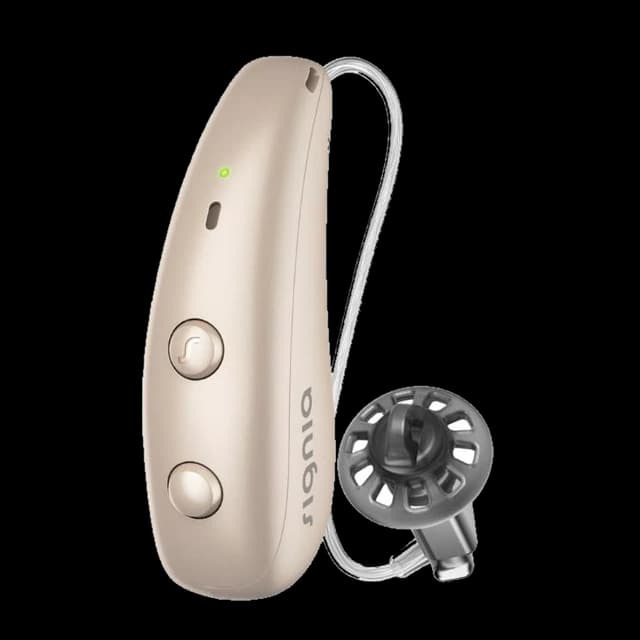
Signia Pure Charge&Go MaX rechargeable hearing aid in beige, shown with receiver and dome

At a Glance

  • Speech, own-voice, scene, and noise each handled by a dedicated neural network rather than one general-purpose model
  • A single connectivity package — OneConnect — covering Bluetooth Classic, LE Audio, telecoil, and Auracast without picking a special variant
  • Own-voice tuning happens automatically, removing a step that used to be done in the clinic
  • Pure Charge&Go MaX, rechargeable, eight finishes; half an hour in the case buys roughly six hours, and the case itself stores four complete charges
  • Receiver-in-canal only for now — anyone needing a custom shell, an earbud shape, a power BTE, or a CROS setup should look at Signia IX

Signia MaX Video

The Technology Inside Signia MaX

Why Four Networks and Not One

Splitting the task is the substantive change. A single model tuned to suppress background sound has no way of knowing whether you are mid-conversation, whether the voice it just found belongs to you, or whether you have walked from a quiet corridor into a crowded hall. Miss any of those and the aid helps in the wrong direction — flattening a room you were listening to, or dipping your voice the instant you start talking. Dedicated networks are Signia's answer. Whether four beats one for your particular hearing is not something the published record can settle today.

Reading the Manufacturer's Numbers

Two headline results accompany the launch: that MaX beat unnamed rival devices for 97 per cent of wearers in noisy group settings, and that it leads on signal-to-noise performance in the same conditions. Trace either back and you arrive at in-house Signia white papers from 2026 that have not been released, with no disclosed protocol or sample. A third figure — a 54-fold gain in processing capacity, half again the energy efficiency, double the memory — is supported by a footnote whose entire content is that the yardstick was Signia IX. We are not suggesting the engineering is overstated; internal validation is normal and necessary. We are pointing out that nobody independent has looked, and that silicon capacity is a poor proxy for what a patient notices in a crowded room.

Ask Specifically About Auracast

Every summary of MaX lists Auracast, and the chip does support it. What the summaries omit is Signia's own timetable: the feature is switched on by a firmware release due before March 2027. Today the aid is prepared for broadcast audio rather than able to use it. Given how hard the whole industry is promoting Auracast at the moment, that gap is worth naming. The built-in telecoil is live now and handles most loop-equipped theatres, halls, and houses of worship in Westchester.

The Gaps, Stated Plainly

Outside testing: none, from any laboratory. Pricing: unannounced at every level. Also missing are the performance-tier breakdown, the fitting range, receiver strengths, and an ingress rating for dust and water. One absence stands out to us — tinnitus. Signia equips the IX family with tinnitus therapy as a matter of course, yet none of the MaX material refers to it. The likeliest explanation is that it simply carries over, but we would rather open the fitting software and check than print an assumption.

Eight Finishes, and Why It Is Not a Trivial Choice

MaX is made in eight colours — Beige, Black, Chestnut Brown, Dark Champagne, Honey Blonde, Rose Gold, Silver and Titanium Grey. The finish alters nothing about the sound; the hardware underneath is identical. We mention it because it is one of the few parts of this decision that belongs entirely to you, and because it counts for more than specification sheets imply. Hearing aids only help while they are being worn, and hours per day is the strongest single predictor of benefit anyone has measured. Patients hoping the device will vanish against hair or skin generally settle on Beige, Honey Blonde or Chestnut Brown. Those who would rather it look like a piece of technology than a medical appliance usually prefer Black, Titanium Grey or Silver. At the fitting we hold the real finishes against your hair rather than asking you to pick from a screen.

The Fitting Decides More Than the Platform

Specifications describe potential, not outcome. Every device we dispense is set to your prescription and then measured in your own ear canal with a probe microphone, and adjusted again over subsequent appointments as your hearing settles. Out-of-the-box manufacturer settings commonly land under target, which is how a thoroughly verified mid-tier aid ends up outperforming a premium one nobody checked. No amount of neural processing rescues amplification set wrong at the frequencies that matter to you.

Frequently Asked Questions

What does MaX stand for?

Multi-adaptive Xperience. Signia names its platforms this way — AX was Augmented Xperience, IX was Integrated Xperience. MaX is the 2026 generation and the current top of the range.

How does Signia MaX differ from Signia IX?

Three things, practically speaking. The processing is rebuilt around four specialised networks on a faster chip. Own-voice setup no longer needs a calibration step during your appointment. And telecoil plus Auracast hardware come as standard rather than requiring a particular model. Against that, IX is available in shapes MaX is not — custom, earbud, slim, power BTE, and CROS.

Has anyone outside Signia tested it?

No. As of late August 2026 every published figure originates with the manufacturer. Signia IX has been through independent laboratory assessment and performed strongly, so if verified measurement carries more weight with you than platform age, that comparison matters.

Can I get Signia MaX as a custom in-the-ear aid?

Not currently. The launch line-up is one device, the rechargeable Pure Charge&Go MaX, which rests behind the ear with the receiver seated in the canal. Custom shells, instant-fit tips, power behind-the-ear models, and CROS fittings are all available on Signia IX.

Is it worth holding out for, or should I be fitted now?

If hearing is a daily struggle, a properly verified fitting today will serve you better than waiting on a platform whose real-world results are still unmeasured. If your present aids are doing their job, nothing about this launch obliges you to move. Come in to either office and we will give you a straight answer.

Explore Other Premium Hearing Aid Brands

Set Up Your Hearing Consultation with an Expert Today

Product information is educational. For personalized hearing aid recommendations, schedule an appointment with Audiology Associates of Westchester.