Candidacy guide
The Invisible Cochlear Implant (TICI UNICO): Are You a Candidate?
TICI UNICO is not in the U.S. yet. See 5 signs you may be a cochlear implant candidate today and how testing works in Westchester. Book an evaluation.
Read time: 6 min read
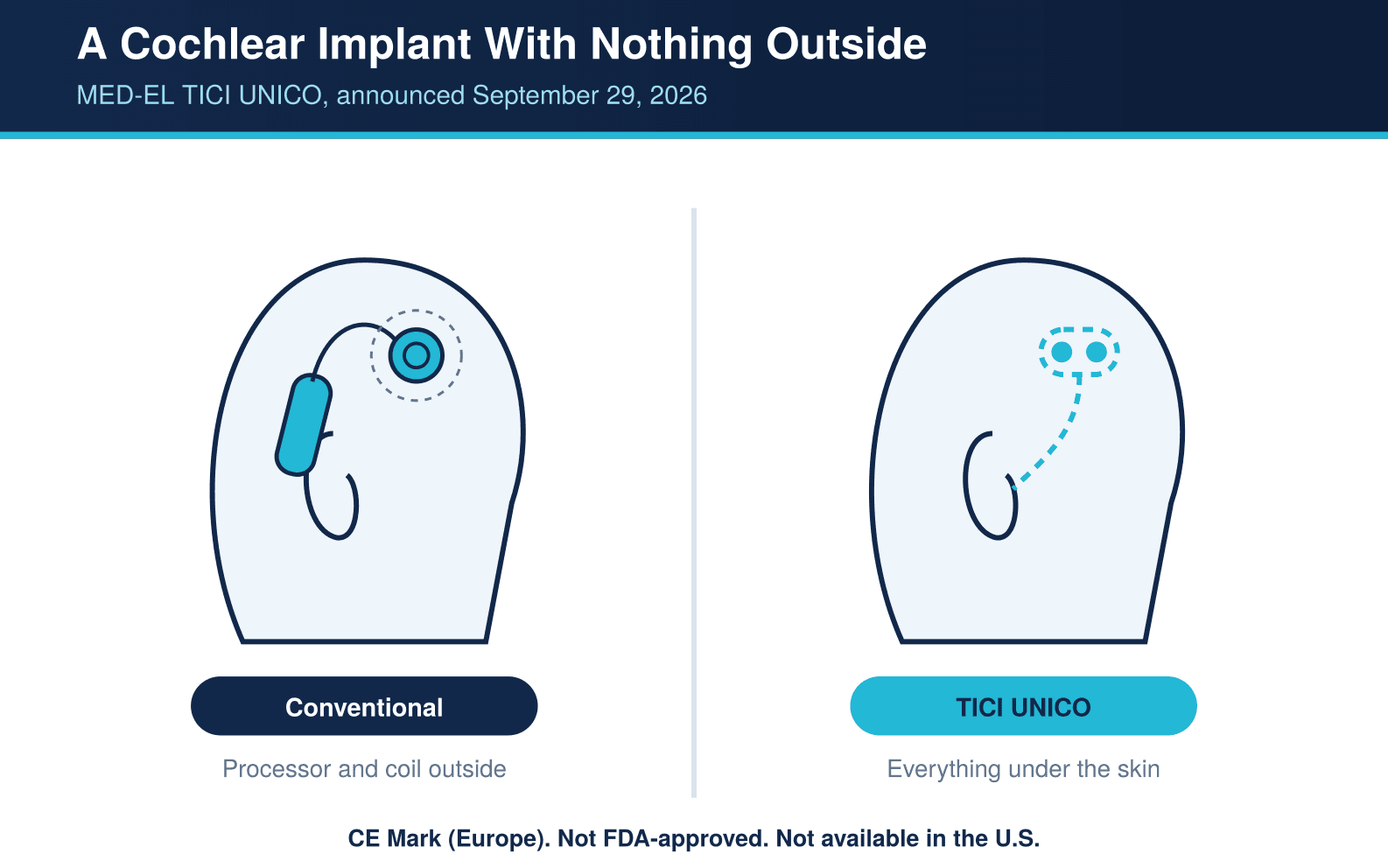
If your hearing aids no longer make speech clear, a cochlear implant may belong in your next conversation. Dr. Caitlin Dold does the cochlear implant testing and programming at Audiology Associates of Westchester. On September 29, 2026, MED-EL gave that conversation a new headline: an implant with nothing worn on the outside.
Where things stand on September 30, 2026: MED-EL unveiled TICI UNICO on September 29 and holds a European CE Mark for it. The FDA has not approved it. No U.S. date or price has surfaced. We do not offer TICI UNICO, and the trial results so far are early. This page covers the news first, then the question that matters more for most readers: could you be a candidate for a cochlear implant today?
“TICI UNICO is real, and it is not available in the United States. If hearing aids no longer give you clear speech, the useful step today is an evaluation.”
Five signs you may be a candidate
Sign 1: Even in a quiet room, speech stays unclear with your hearing aids in. Sign 2: The phone has become hard or impossible to use. Sign 3: You ask people to say things again everywhere, not just in restaurants or crowds. Sign 4: A hearing screen finds a pure-tone average of 60 dB HL or worse, with speech understanding of 60% or less. Clinics often treat that pairing as a reason to refer. Sign 5: Your hearing keeps slipping even though your hearing aids are well fitted and verified. If any of these sounds like you, book a hearing evaluation with aided speech testing. Call (914) 949-0034 or use our contact page. Having the evaluation does not mean you have agreed to surgery.
What the process looks like for a Westchester patient
First we check what your hearing aids are really delivering, using real-ear measurement. An implant talk that starts from under-fitted hearing aids starts in the wrong place. Then we test your hearing and your word understanding, with and without your devices. We explain where your results sit against candidacy criteria. You might not be a candidate, and better-fitted hearing aids might be the answer. If an implant evaluation makes sense, we refer you to an implant surgeon and send the testing with you.
Who does what: Dr. Dold and the surgeon
The surgeon and the hospital handle the surgery. It is not done at our offices. Dr. Dold handles the audiology on either side of it. Before surgery, that is the candidacy testing. After healing, she activates the processor and programs it. Mapping then continues over a series of follow-up visits, and the settings are adjusted for as long as you wear the implant.
Where TICI UNICO fits in
A conventional cochlear implant has an internal part placed by a surgeon and an external sound processor that holds the microphone and battery. A coil joins the two through the skin. TICI UNICO removes the external part. IEEE Spectrum reports that it weighs about 20 grams and has four connected components under the scalp, and that its microphone sits roughly 6 millimeters beneath the skin. MED-EL says a wearer can hear around the clock, including asleep, in the shower, swimming, and while the battery charges.
Conventional implant and TICI UNICO at a glance
Here are the two designs next to each other, limited to details reported so far. Charging for conventional processors is not covered on this page.
| Feature | Conventional implant | TICI UNICO |
|---|---|---|
| Outside parts | External sound processor, plus a coil held on by a magnet | None. No processor and no coil on the scalp |
| Microphone | In the external processor | Under the skin, roughly 6 millimeters below the surface (IEEE Spectrum) |
| Battery | In the external processor | Sits under the skin and cannot be replaced. Reported design target of up to about 40 hours per charge |
| Charging | Not covered in this article | Charged through the scalp by a small magnetic unit, the GoPod. MED-EL says hearing continues during charging |
| U.S. status | Three makers sell systems in the U.S.: Advanced Bionics, Cochlear and MED-EL | Not FDA-approved and not available. No U.S. date announced |
What is known, and what is not
MED-EL reported four commercial implantations on launch day itself. A six-person feasibility study it published in 2025 described a good safety profile and hearing results comparable to conventional implants, and the launch material mentions a larger investigation of about 30 patients. Early results from small groups are a hopeful sign. They say little about how the device performs for years. The launch release left out a price, MRI details and a U.S. regulatory plan, and it was silent on insurer coverage. We will not guess at any of those.
Wait for TICI UNICO, or get tested now?
Get tested now. Cochlear implants need FDA approval before sale in the United States, and no one can give you a date. Three companies sell implant systems here today: Advanced Bionics, Cochlear and MED-EL. All use an external processor. For the right candidate they give large gains in understanding speech, especially in quiet and on the phone. Ears that go a long time without useful hearing tend to do less well after implantation. An evaluation today gives you a baseline that will still be useful if new devices arrive.
Status and last update
Last updated September 30, 2026. This is the page's first version. We will revise it if MED-EL or the FDA shares news on a U.S. plan, a price or MRI details.
Medical information notice
This page offers general information, not medical advice. It does not diagnose anything or recommend a treatment. Whether you should have an implant depends on your test results and on talks with your care team.
Common questions
Does Audiology Associates of Westchester offer TICI UNICO?
No. TICI UNICO lacks FDA approval, so no U.S. practice can offer it yet. We do provide candidacy testing before cochlear implant surgery and programming after it, with Dr. Caitlin Dold.
How much does a cochlear implant cost?
Many insurers cover cochlear implants, including Medicare when its criteria are met. Your own share of the bill depends on your plan. Before you commit, ask the implant program to run a benefits check for you.
What happens at a cochlear implant evaluation?
We begin by measuring what your hearing aids deliver in your ears. Next come tests of hearing and word understanding, with and without the devices, and a plain explanation of how you compare with candidacy criteria. If an implant evaluation is the next step, we refer you to an implant surgeon and send the results along.
Can poorly fitted hearing aids make me look like a candidate?
They can muddy the picture, so we verify your hearing aids first. A talk about implants that begins with under-fitted devices begins in the wrong place.
What do we still not know about TICI UNICO?
At launch MED-EL did not share a price, MRI details or a U.S. regulatory plan. Nor did it say whether U.S. insurers would cover the device. The trial results come from small groups over a short period.
Who does the surgery?
An implant surgeon operates at a hospital, not in our offices. Our part is the testing beforehand and the activation and programming afterward, led by Dr. Dold.
TICI UNICO is not in the U.S. yet.
Get one email the week anything changes.