OTC and prescription hearing aids
OTC vs Prescription Hearing Aids: A Short Decision Guide
Decide between over-the-counter and prescription hearing aids with a short checklist, a 2025 trial summary and red flags. Book in Westchester.
Read time: 8 min read
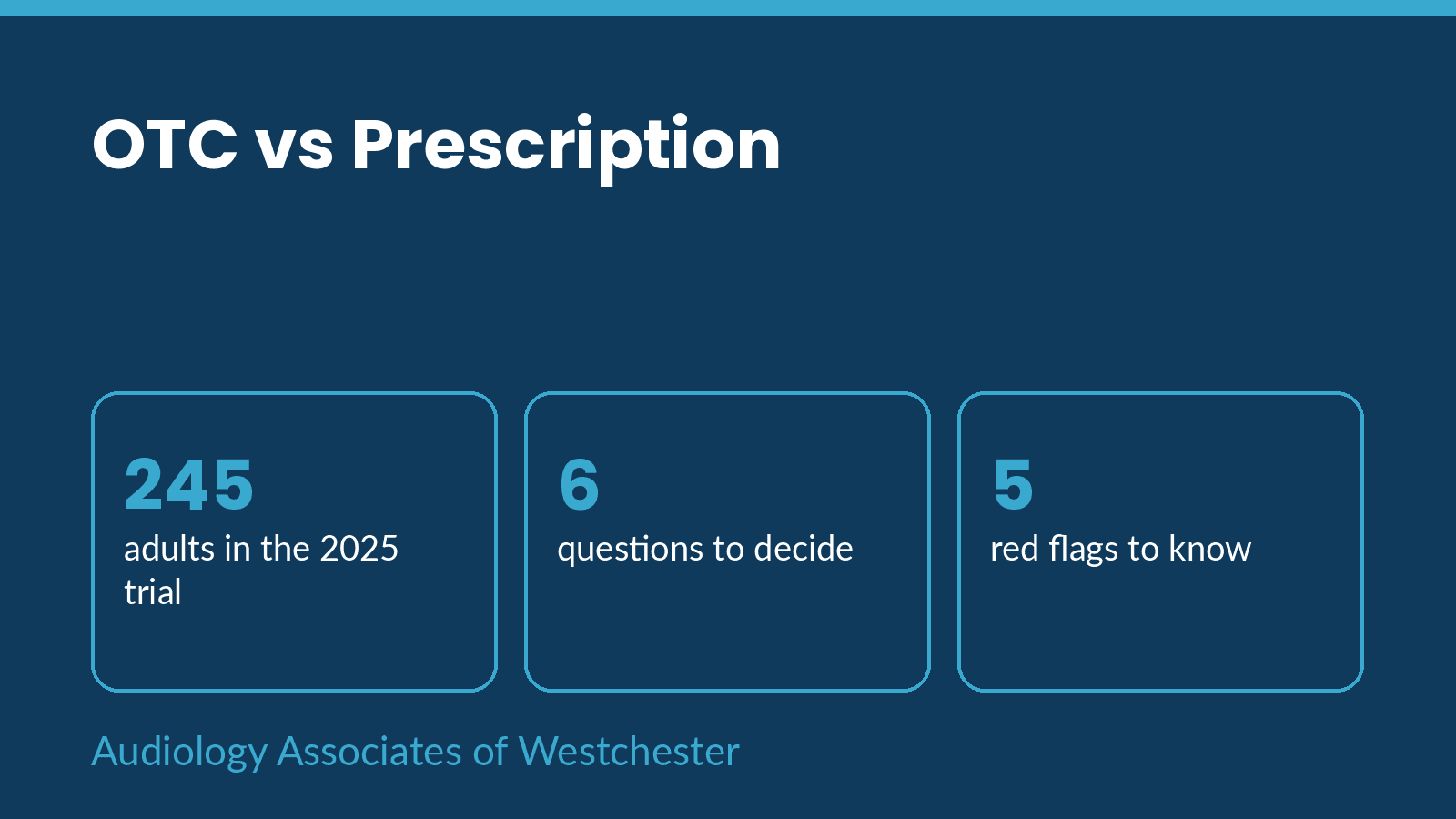
Over-the-counter aids are for adults who perceive mild to moderate hearing loss and want to set up a device themselves. Prescription aids come with a hearing test, a professional fitting and follow-up. This page gives you six questions to decide, a summary of the best recent trial and the red flags that mean see a professional first.
We are an audiology practice, so we have a view. We give the evidence as it stands, including where it does not apply to you. For our earlier take, see OTC vs prescription hearing aids in the real world and our comparison with listening aids.
“The service mattered more than the technology tier.”
Six questions to decide
Answer each question honestly. If any answer is in the right-hand column, a professional visit comes first.
| Question | OTC may fit if | See a professional first if |
|---|---|---|
| Is your loss mild to moderate? | Yes, and both ears seem similar | It seems more than moderate |
| Has it come on slowly? | Yes, over months or years | It came on suddenly |
| Both ears? | Yes | One ear only |
| Any pain, drainage or dizziness? | No | Yes |
| Any ringing in one ear? | No | Yes |
| Do you want a measured fit and follow-up? | Not needed | Yes |
What the 2025 trial found
A two-site randomized trial of 245 adults aged 55 and older with mild to moderate loss and no earlier hearing aid use found that audiologist-fitted aids beat over-the-counter aids on its main measure. It also found no significant difference between high-end and low-end aids. The service mattered more than the technology tier (Wu and colleagues, JAMA Otolaryngology, 2025).
What the trial does not cover
It does not cover severe loss, one-sided loss, younger adults or experienced users. It tested particular devices, so it cannot rank every product. Use it as evidence about the value of support.
Red flags: see a professional first
Sudden hearing loss, loss in one ear, ear pain or drainage, dizziness and ringing in one ear all need a medical check before any device. Children need a professional. Our page on signs you need hearing aids lists more.
What a fitted aid adds
A hearing test, a measurement inside your ear, programming to your results and follow-up visits. HearAdvisor's lab scored a Phonak flagship 3.1 of 5 for speech in noise at first fit and 5.0 after tuning. See our hearing aid fitting page.
Book a visit
Call our Harrison office at (914) 949-0034 or our Somers office at (914) 556-6720 to book a visit. Harrison is at 550 Mamaroneck Avenue, Suite 407. Somers is at 325 NY-100. A hearing test shows which path fits.
Last updated and sources
Last updated November 4, 2026. What changed: this is a new decision guide.
Medical information
This page gives general information. It is not medical advice and it does not diagnose or recommend treatment. Sudden hearing loss, hearing loss in one ear, ear pain or dizziness need prompt medical care. Call Harrison at (914) 949-0034 or Somers at (914) 556-6720.
Common questions
Are OTC hearing aids safe?
For adults with mild to moderate loss and no red flags, they are designed for that use. A hearing test still helps.
Are prescription aids better?
A 2025 trial found fitted aids beat OTC aids on its main measure in adults 55 and older.
Do I need a test before OTC aids?
It is not required, but it helps.
Can you adjust OTC aids?
Call us. We can say what is possible for your device.
Does a higher price mean better results?
The 2025 trial found no significant difference between high-end and low-end aids.
Who should skip OTC?
Anyone with a red flag, and children.