Hearing aid comparison
Open-Ear Hearing Aids Compared: Liberte, Open-Fit RICs and Earbud-Style Aids
Compare Cearvol Liberte, prescription open-fit RICs and earbud-style OTC aids on fit, setup, price and who each suits. Book a hearing evaluation first.
Read time: 7 min read
Many people put off hearing aids because they hate the plugged-up feeling. On October 27, 2026, Cearvol launched Liberte, an over-the-counter aid that holds a small speaker above the ear canal instead of sealing it. It is one of three ways to get amplified sound without a tight seal. This page compares them side by side.
Product details below are the companies' own claims from their launch announcements. We have seen no independent testing of Liberte. Launch prices change, so check the brand's page before you buy.
“Open-ear designs solve the comfort problem. They do not solve the diagnosis problem.”
Three designs for people who dislike a plugged ear
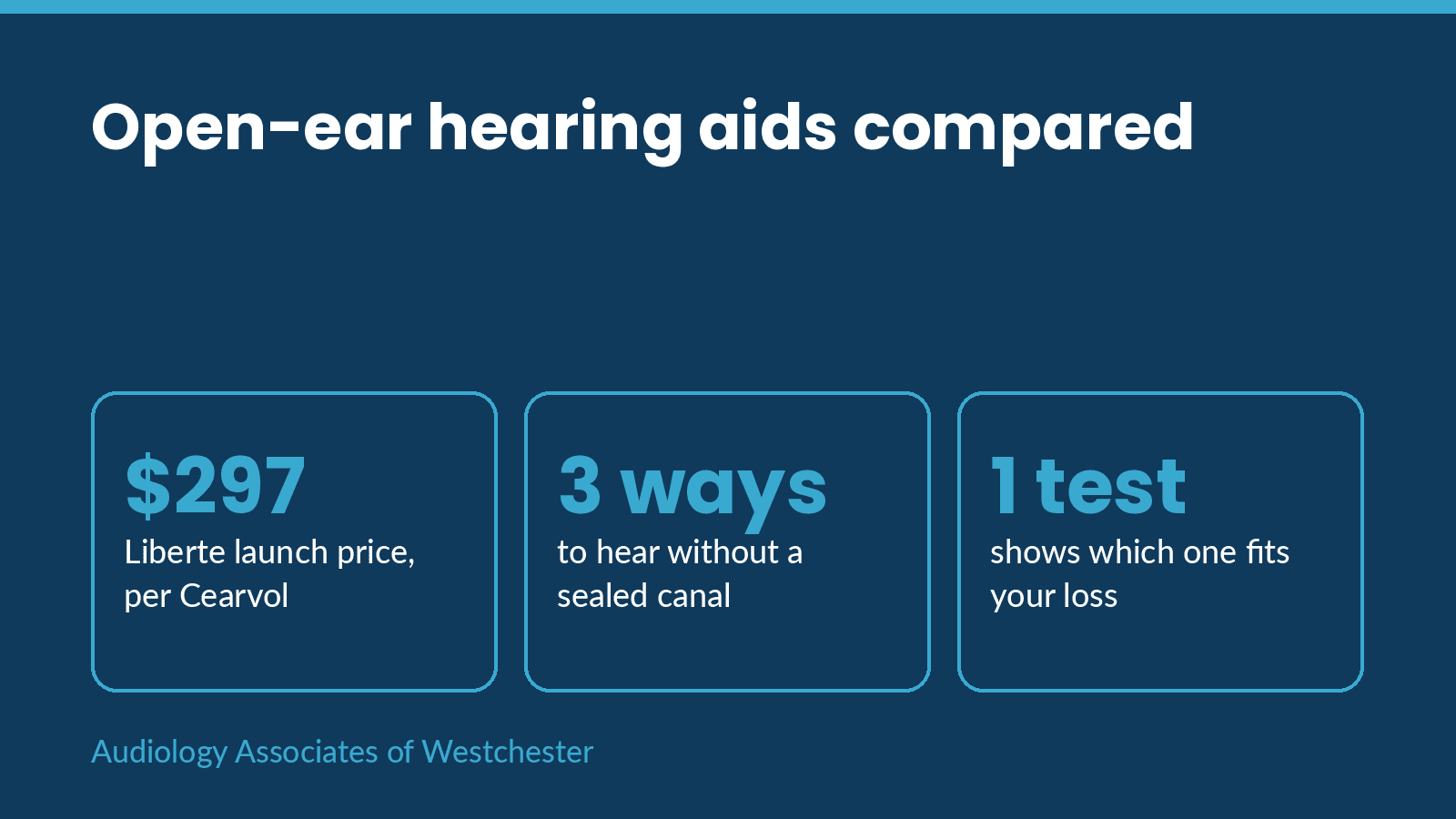
True open-ear OTC. Cearvol says a flexible titanium wire rests behind the ear and suspends a driver above the canal, with nothing inside it. You set it up yourself in an app. A prescription open-fit receiver-in-canal aid (RIC) places a small speaker in the canal, held by an open dome with air gaps, and your audiologist programs it from your audiogram. An earbud-style OTC aid, such as the Elehear Beyond 2 Pro, sits in the ear like a wireless earbud and is also self-set. Our page on the Elehear Beyond 2 Pro covers that design in detail.
The comparison table
The table sets the three designs against the things that decide a purchase. Read the last two rows twice. They are where most buyers' surprises come from.
| Item | Open-ear OTC (Cearvol Liberte) | Prescription open-fit RIC | Earbud-style OTC (Elehear Beyond 2 Pro) |
|---|---|---|---|
| Form factor | Wire behind the ear holds a driver above the canal, per Cearvol | Behind-the-ear body, thin wire, small speaker in the canal | Sits in the ear like a wireless earbud |
| Ear canal | Open. Nothing inside it, per Cearvol | Open or closed dome, chosen by your audiologist | In the ear. Ask about tip and seal options |
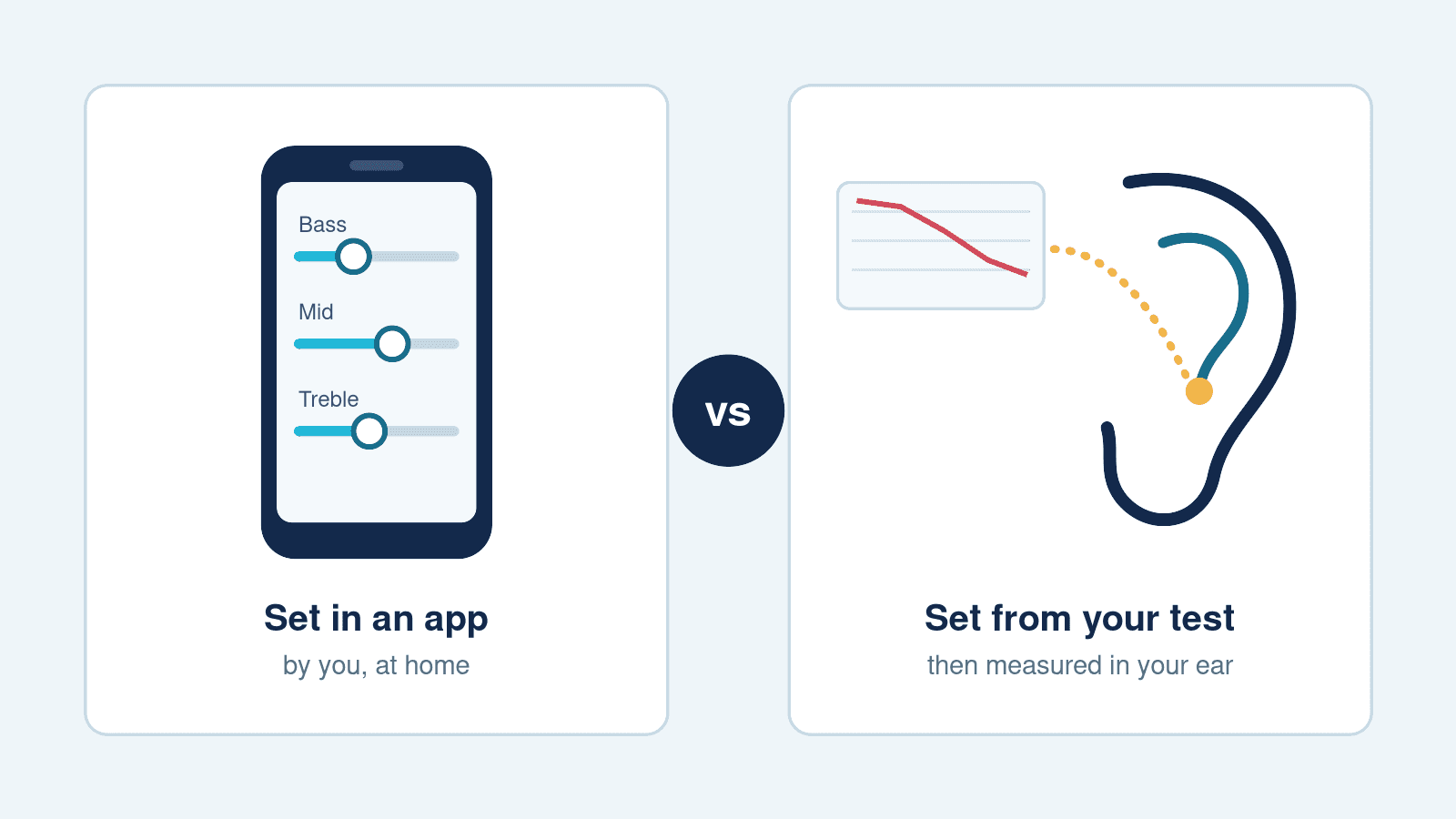
| Set-up | You choose a profile in the app | Programmed from your audiogram | You set it in the app unless you add remote audiology |
| Verification | None described in the launch release | Real-ear measurement by your audiologist | None unless you add remote support |
| Streaming | Multipoint Bluetooth, per Cearvol | Varies by model. Bluetooth is common | Bluetooth and Auracast, per launch coverage |
| Battery | Up to 14 hours plus 30 in the case, per Cearvol | Varies by model | Varies. Check the brand's page |
| Price band | $399 MSRP, $297 launch price, per Cearvol | Varies by technology level. See our cost guide | $799 a pair per launch coverage |
| Best fit | Mild loss, high pitches, dislikes plugged ears | Mild to severe loss, depending on the model | Mild-to-moderate loss, comfortable with apps |
What a fitting adds that a self-check cannot
An audiogram measures your hearing at each pitch, and a prescription fitting uses it to decide how much amplification you need. Real-ear measurement then checks the sound actually reaching your eardrum, which varies from ear to ear. Our page on why real-ear verification matters explains the step. Open designs need especially careful tuning, because sound leaks out and can loop back as whistling. A self-check in an app does not measure any of this. It can still be enough for a mild loss. It cannot tell you whether a medical cause is present.
What open designs gain, and what they give up
Open designs avoid the booming of your own voice and keep you aware of your surroundings. They also work well with glasses and masks, per Cearvol. The trade-off is physics. With the canal open, low-pitched sound escapes and amplified sound leaks, so these designs work best for mild-to-moderate loss, mostly in the high pitches. Deeper or more uneven loss usually needs a sealed or custom fit with more gain. For the wider decision, see prescription versus OTC hearing aids.
Who should skip OTC and book first
Book an evaluation before buying any self-fit aid if you have sudden hearing loss, loss in one ear only, ear pain or drainage, dizziness, or ringing in one ear. Those are medical signals, not shopping questions. Our page on whether OTC hearing aids are right for you lists them. Neither route replaces an exam when a red flag is present.
A note for patients
Open-ear designs solve a real comfort problem. They do not solve the diagnosis problem. Nobody can tell from a product page whether your hearing loss is the kind these devices can help. That is the evaluation's job.
What to do next
Book a hearing evaluation at our Harrison or Somers office, or call (914) 949-0034. Read what happens at the visit on our page about the comprehensive hearing evaluation. See how the other new launches compare: listening aids and OTC aids and Certus Max. Our overview of fall 2026 hearing aid platforms covers the prescription side.
Status and last update
Last updated October 28, 2026. Change note: this is the first version. We will update the table as pricing changes and add independent reviews if credible ones appear. Sources are listed at the end of this page.
Medical information notice
This article explains product announcements and published research for general education. It is not medical advice, and it does not diagnose or treat any condition. Sudden hearing loss, ear pain, drainage and dizziness need prompt medical care. Call (914) 949-0034 to book at our Harrison or Somers office.
Common questions
What is the difference between open-ear and open-fit hearing aids?
Open-ear usually means nothing seals the canal, as with Cearvol's design. Open-fit means a prescription receiver-in-canal aid with an open dome that leaves air gaps. Your audiologist chooses the dome for your loss and your ear.
Can an open-ear OTC aid replace a prescription aid?
For some mild losses it may help. It is not a substitute for a fitted aid if your loss is larger, uneven or has a medical cause. A hearing test shows which group you are in.
Is Cearvol Liberte the best open-ear hearing aid?
We cannot say. We have not seen independent testing, and no single device is best for every loss. The right choice depends on your measured hearing, your ears and how you live.
How does Liberte compare with the Elehear Beyond 2 Pro?
Liberte is an open-ear design priced at a $297 launch price per Cearvol. The Beyond 2 Pro is an earbud-style design that launch coverage listed at $799 a pair. Both are self-set unless you add remote support.
Do you sell or fit Cearvol Liberte?
No. We test hearing and fit prescription hearing aids. If you buy an OTC aid and want to know how you are hearing, we can test your hearing.