The evidence
One Hearing Aid or Two? The Duke Trial in Plain Words
275 adults wore one or two hearing aids for three months. Two helped more on average, and many started with one. What it means for you. Call our offices.
Read time: 5 min read
Price is a big reason people ask whether one hearing aid is enough. A 2026 trial from Duke University gives a clearer answer than we have had before.
Here is what the trial did, what it found, and how we talk it through with patients in Harrison and Somers.
“If two help more on average, the question for you is still personal.”
The trial
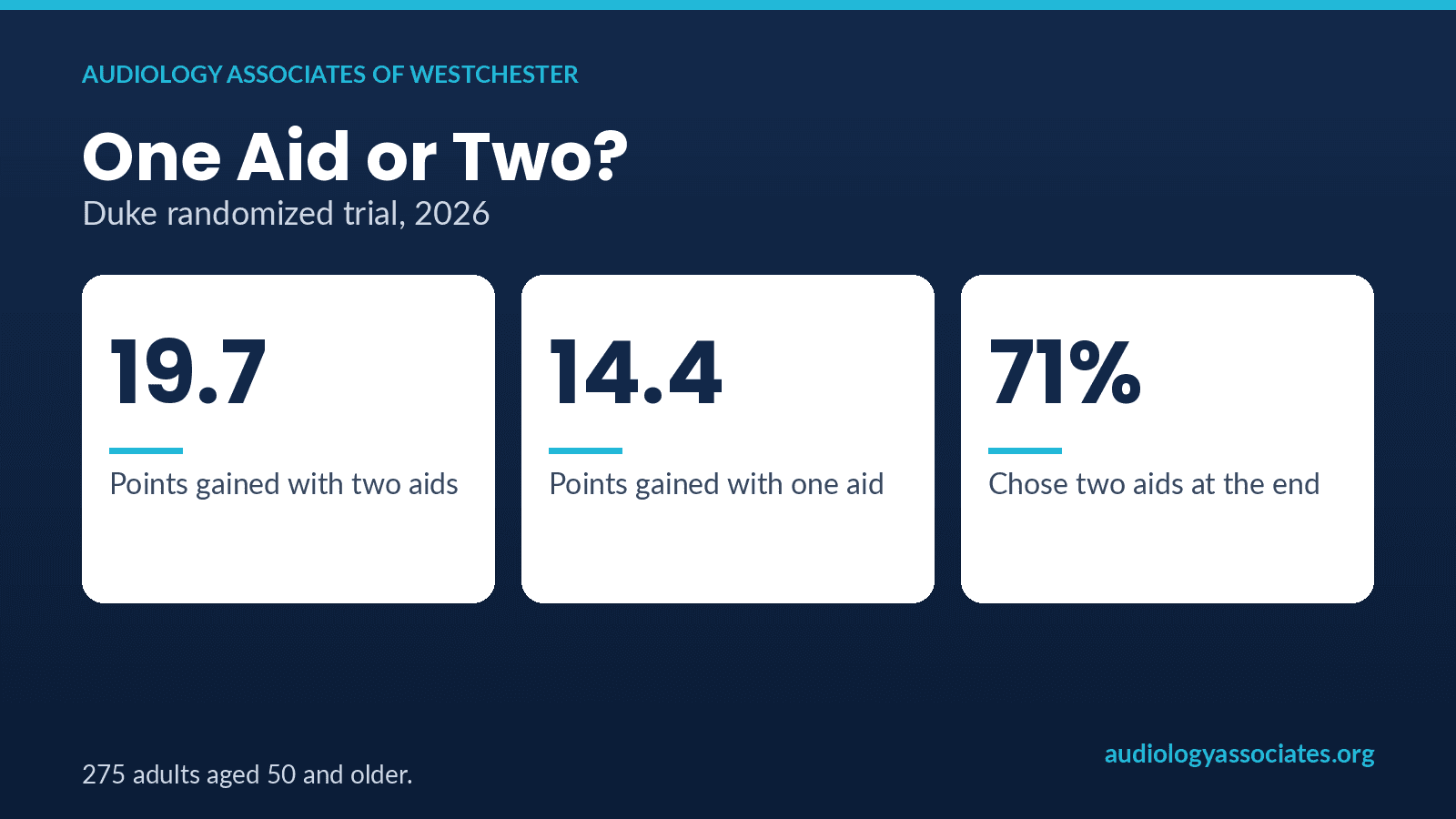
Researchers led by audiologist Sherri Smith, working at Duke University, enrolled 275 adults aged 50 and older with mild to moderate hearing loss, mostly in the high pitches. Nearly all were new or nearly new to hearing aids. A random draw assigned each person to wear one aid or two for three months. At the end, each person chose to keep, switch or stop.
The results
On a 100-point questionnaire about communication in daily life, the one-aid group improved by 14.4 points and the two-aid group by 19.7. About 71% ended up choosing two aids, about 29% chose one, and fewer than 1% chose none. Of those who began with one, roughly 6 in 10 added a second.
How to read a 5-point gap
The difference was statistically significant, but the reviewer at HearingTracker notes that its meaning in daily life is not yet clear. Averages hide people. Some did very well with one aid. If a trial shows that two help more on average, the question for you is still personal: what do your test, your lifestyle and your budget say?
| Measure | One aid | Two aids |
|---|---|---|
| Average improvement at 3 months | 14.4 points | 19.7 points |
| Final choice | About 29% | About 71% |
| Adults enrolled | 275 in all | 275 in all |
| Started with one, then added a second | Roughly 6 in 10 | Not applicable |
How we decide with you
We test both ears first at a hearing test. If both need help, we usually talk about two, and we say why. If cost is the barrier, we explain how to start with one and add another, and we show our payment plans and ranges in our cost guide. We never push a brand.
Where to read next
See the Cochrane summary, types of hearing aids and rechargeable aids. A second opinion visit can review a quote for one or two aids.
Last updated and sources
Last updated November 24, 2026. What changed: this is the first version. We will update this page when new evidence or rules change the picture. Sources are listed at the end of the article. This page offers general information. It is not a diagnosis or treatment plan.
Common questions
Do two hearing aids work better than one?
On average, yes. Two gave more benefit in the 2026 Duke trial. One helped too.
How many people chose two?
About 71% chose two aids at the end of the trial.
Can I add a second aid later?
Yes. About 6 in 10 who started with one added a second.
Does the trial apply to me?
It covered adults 50 and older with mild to moderate, mostly high-pitch loss. A hearing test shows whether you match.
What if I can afford only one?
Tell us. We will explain how to start with one and plan for a second.