Hearing aid battery comparison
Rechargeable Hearing Aids: A Guide to Battery Claims, Chargers and Trade-offs
Compare battery claims and chargers for 2026 hearing aids, then match a charger to your routine. Book a fitting visit in Harrison or Somers.
Read time: 8 min read
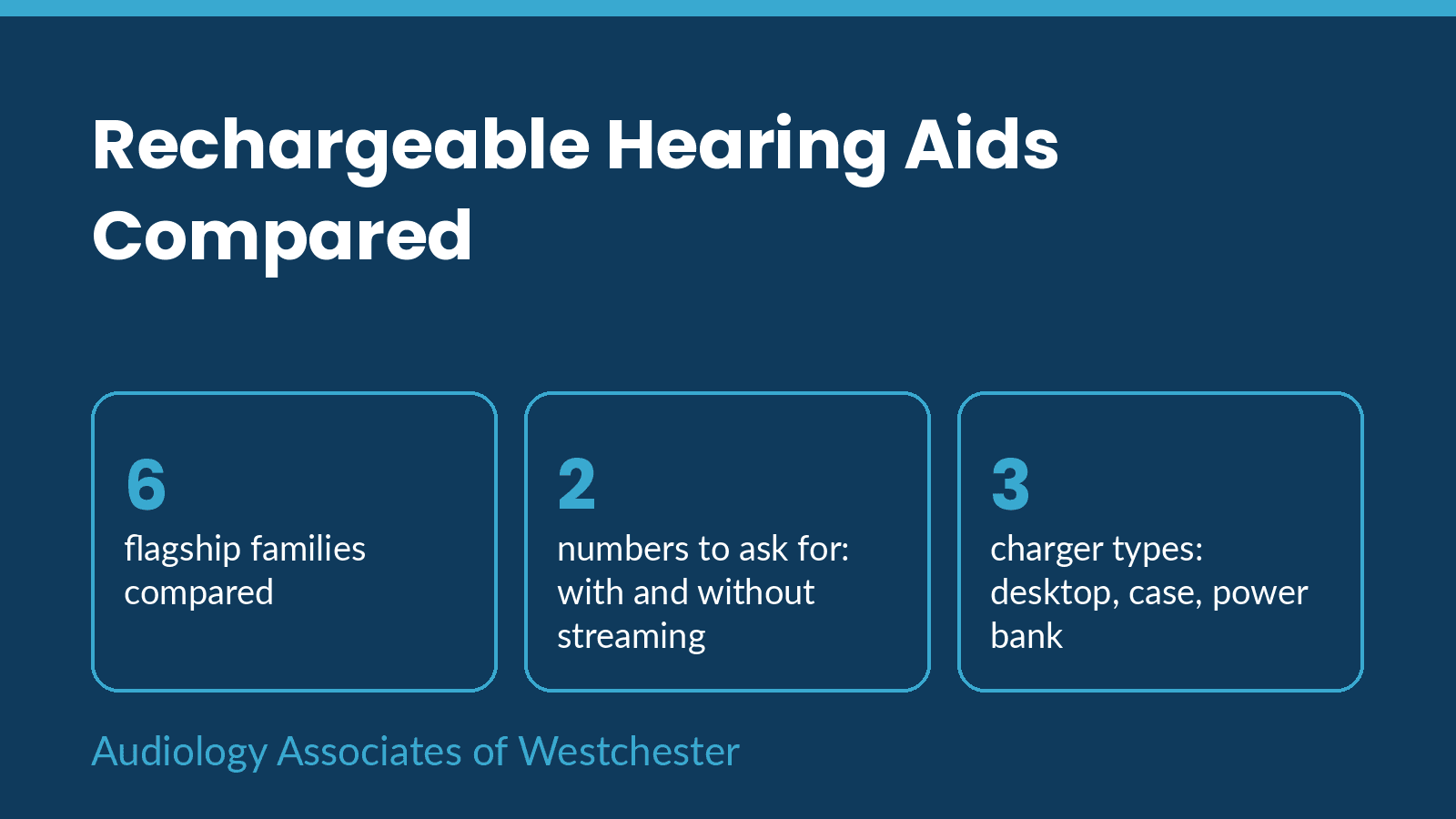
A rechargeable hearing aid holds a sealed lithium-ion cell that you refill on a charger each night, instead of changing a small zinc-air battery. Most 2026 flagships come this way. Makers quote anywhere from about 24 to 51 hours per charge, and every one of those numbers depends on how much you stream and what the aid is doing for you.
This guide reads those claims the way a careful buyer would. It shows what each maker says, what the number assumes and which question to ask before you buy. It then helps you choose a charger that suits your routine, and it says who should still choose disposable batteries.
“A battery number has two parts: the hours, and the conditions behind them.”
Battery claims side by side
Use the table to see what each maker states and what that figure assumes. Where a source did not give a number, the table says so. None of these figures comes from our own testing.
| Flagship | Headline claim | What the claim assumes | Charger | Ask before you buy |
|---|---|---|---|---|
| Phonak EON | Up to 38 hours | About 22 hours with heavy streaming and frequent noise reduction | Desktop charger and portable ChargerGo with its own battery | Who replaces the cell, and when? |
| Oticon Reveal | No hour figure in the sources we checked | Oticon says use time depends on use pattern, features, hearing loss and battery age | Not stated in the sources we checked | What is the hours-per-charge figure for my receiver? |
| Signia MaX | Up to 28 hours (UK launch); about 30 hours (HearingTracker) | The 28-hour figure includes 5 hours of streaming | Pocket charger holds up to four full charges | Which figure applies to my tier? |
| ReSound Sensia | At least 24 hours, up to about 30 | Depends on usage; streaming not stated | A smaller portable premium charger is planned | Does the figure include streaming? |
| Starkey Omega AI+ | Up to 51 hours (RIC RT); about 42 for mRIC and custom | Without streaming | Premium charger with its own battery charges up to 3 times | What is the figure with streaming? |
| Widex Allure AI RIC | Up to 32 hours | Includes 6 hours of AI use or streaming | Standard, Charge & Clean and portable Qi-enabled chargers | Which charger comes with my quote? |
Reading a battery claim
A battery number has two parts. The first is the hours. The second is the conditions. Phonak states up to 38 hours for EON and about 22 hours with heavy streaming and frequent noise reduction. Signia's UK launch material cites up to 28 hours including five hours of streaming. Widex counts six hours of AI use or streaming inside its 32 hours. Starkey separates its 51-hour figure, which has no streaming, from its 42-hour figure for smaller models. When you compare two aids, compare the same conditions, and ask for the figure that matches how you really listen.
Which charger fits your life
Think about where you sleep, where you travel and how often the power fails. A desktop charger on a bedside table suits someone who is home every night and wants the simplest routine. A portable case that holds its own battery suits someone who travels, camps, or lives with outages. Phonak sells both kinds, Signia's pocket charger holds up to four full charges and Starkey's premium charger charges up to three times. If your case takes USB-C, an ordinary phone power bank works too. Pick the charger first, then check which models offer it.
What streaming does to your day
Wireless streaming asks the battery to do more work than amplification does. An afternoon of calls plus a film on the plane can leave a pair nearly flat by bedtime, even though the same aids last a full day without streaming. This is normal and not a fault. If streaming is part of most of your days, tell us at the fitting. It changes which model and which charger we suggest.
How long the cell lasts
HearingTracker describes lithium-ion cells in hearing aids as generally lasting about five years, with a limited lifespan of three to five years, and says capacity may drop to roughly 85 percent after the first year. In practice, you notice a day that stops lasting until bedtime. Replacement usually goes through the maker. Phonak EON is listed with a battery your hearing care provider can replace, and HearingTracker describes an end-of-warranty refurbishment that can include new batteries. We check what applies to your model before any decision.
Who should keep disposable batteries
Disposable batteries last only a few days to a little over a week, but they cost little and they swap in a minute. They suit people who often lose power, people who cannot keep a charging routine and people who wear a style that does not come rechargeable. Most of the smallest custom aids still use disposable cells, and Starkey offers its Omega AI line in both rechargeable and size 312 versions. A rechargeable choice should make your day easier. If it does not, a disposable version is a sound choice.
Questions to ask any seller
Ask for hours per charge with streaming. Ask how long a quick charge takes and what it returns. Ask whether the charger has its own battery. Ask who replaces the cell, how long that takes and what it costs. Ask whether the same model comes in a disposable-battery version. Ask what the warranty says about battery wear. Our guide to hearing aid fitting explains what a good visit should include.
Book a fitting visit
Call our Harrison office at (914) 949-0034 or our Somers office at (914) 556-6720 to book a visit. Harrison is at 550 Mamaroneck Avenue, Suite 407. Somers is at 325 NY-100. We fit both rechargeable and disposable models across the major brands, and we start with a hearing test and a conversation about your day.
Last updated and sources
Last updated November 4, 2026. What changed: this is the first version. Figures are maker claims or third-party listings as of this date, and they change with firmware and new models. Confirm the figure for the exact model on your quote.
Medical information
This page gives general information. It is not medical advice and it does not diagnose or recommend treatment. Sudden hearing loss, hearing loss in one ear, ear pain or dizziness need prompt medical care. Call Harrison at (914) 949-0034 or Somers at (914) 556-6720.
Common questions
How long does a rechargeable hearing aid last on one charge?
Makers claim about 24 to 51 hours for 2026 flagships, but the biggest numbers assume little or no streaming. Compare claims under the same conditions, and ask for the figure with streaming.
Is it safe to charge hearing aids every night?
Yes. Charging overnight is how rechargeable aids are designed to be used, and it prevents the most common problem, which is starting the day half empty.
What happens when the rechargeable battery wears out?
It declines slowly, and you notice a day that stops lasting until bedtime. Replacement usually goes through the maker or your hearing care provider. Ask about the process before you buy.
Can I charge hearing aids from a power bank?
Often yes, if the charging case takes USB-C. Check your case, and check the voltage rating before you travel abroad.
Which styles cannot be rechargeable?
The smallest custom styles usually use disposable batteries because there is no room for a rechargeable cell, and extended-wear devices have no battery for you to change.
Should I choose disposable batteries?
Consider them if you lose power often, if you cannot keep a charging routine or if the style you want does not come rechargeable. They cost little and swap in a minute.
Sources and further reading
- HearingTracker: Best Rechargeable Hearing Aids of 2026
- HearingTracker: How long rechargeable hearing aid batteries last
- HearingTracker: ReSound Sensia launch
- Hearing Review: Phonak EON launch
- Audiology Worldnews: Signia MaX
- Hearing Health Matters: Widex Allure AI
- California Hearing Center: Rechargeable hearing aids