Checklist
Leaf Blower Noise and Your Hearing: A Fall Yard-Work Checklist for 2026
How loud is a leaf blower, how long is too long, and how to read a hearing protector's NRR. A fall yard-work checklist for Westchester. Ask us anything.
Read time: 6 min read
Fall cleanup is one of the few jobs at home that puts a loud, handheld engine next to your ears for an hour or more. Many Westchester lots have mature oaks and maples, so the work can run across several weekends. This page is a checklist for that job. It covers how loud a leaf blower can be, how long that sound is safe, how to read the rating on a hearing protector, and when ringing afterward is a reason to book a test.
We kept to published figures. Where a source gives a range or a limit, we give the source. Where no source gives a number for your own tool, we say so and suggest how to check it yourself.
“The dose adds up across the whole day, so every loud tool counts toward the same limit.”
How loud is a leaf blower?
NIOSH, the US government's workplace safety research body, reports maximum levels for leaf blowers of 95 to 106 dBA across the models tested. Those figures come from a 2016 study by Balanay and colleagues that NIOSH cites. They are peak readings for different models, not the average you would receive across an afternoon, and the distance and the tool's condition change them. NIOSH calls noise hazardous at 85 dBA and above. For comparison, the same table lists push mowers at 86 to 92 dBA and riding mowers at 88 to 96 dBA. Without a meter, NIOSH offers a rough check: if you have to raise your voice to talk to someone about 3 feet away, the noise is probably at least 85 dBA. NIOSH also points to its free Sound Level Meter app. A phone is not a calibrated instrument, so treat the reading as a guide.
Gas or battery?
A NIOSH study of landscaping crews found that workers were exposed to significantly more noise, and more carbon monoxide, with fuel-powered leaf blowers, string trimmers and chainsaws than with battery-powered versions. Of 119 eight-hour average measurements, 94 met or exceeded NIOSH's 85 dBA limit, and gas leaf blowers were among the loudest tools. That study followed professional crews working full days. A homeowner who runs a blower for 30 minutes has a very different dose. The finding does not mean a battery blower is quiet. It means that, in that study, the battery tools were quieter than the fuel tools. Check the sound figure on the box if the maker prints one, and test the tool with the raised-voice check above. If you hire a crew, they carry the larger share of the exposure, and a neighbor's blower can add to yours.
How long is too long?
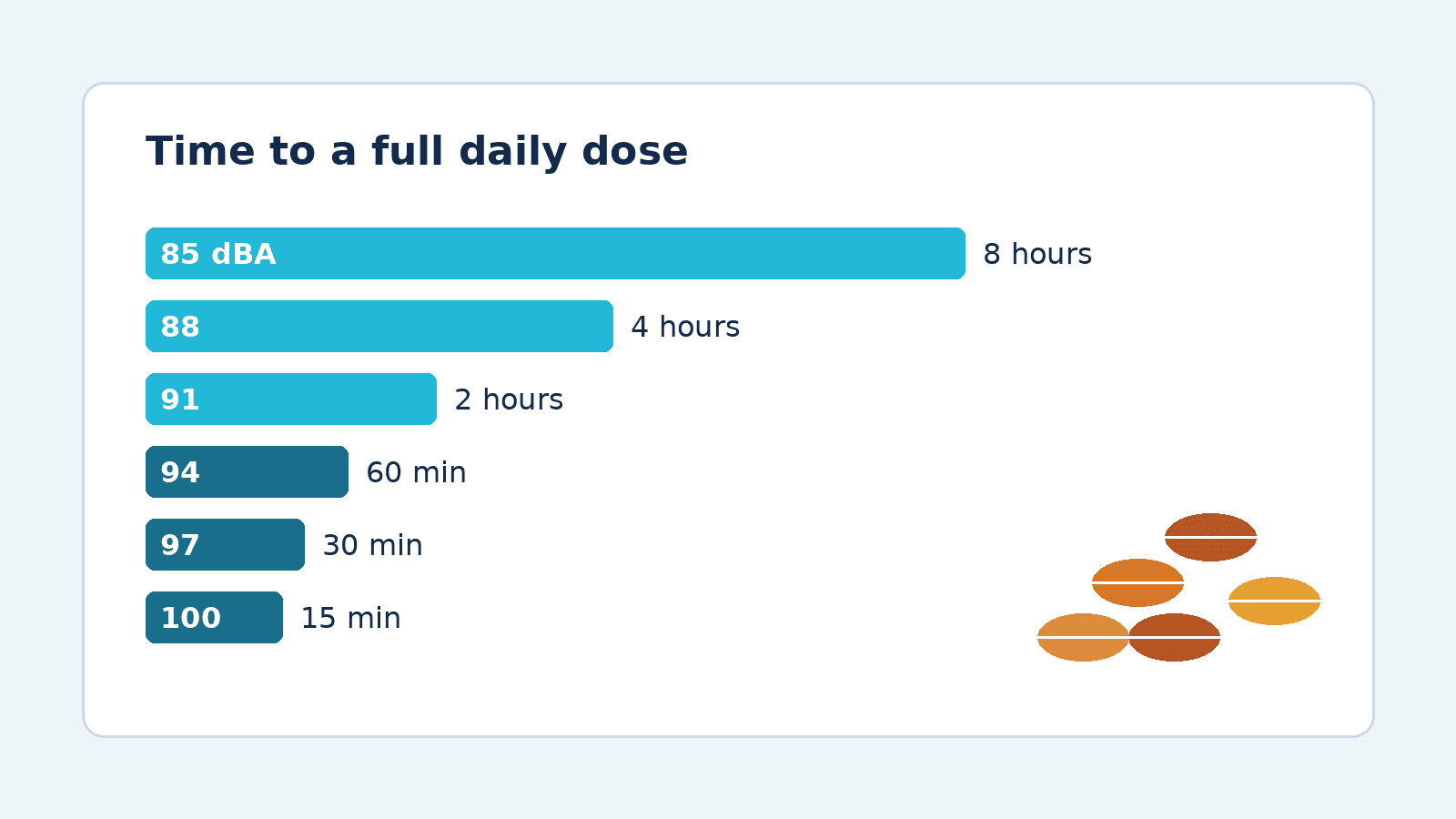
NIOSH sets its recommended exposure limit at 85 dBA averaged over eight hours. It uses a 3 dB exchange rate, which means that for every 3 dB the level rises, the allowed time is cut in half. The table below shows the time to reach 100 percent of a daily noise dose at each level. NIOSH sets this limit for workplaces. We use it here as a reference point for a long yard job, not as a rule written for backyards. Two cautions apply. First, the dose adds up over the whole day. Time on a blower, a trimmer and a mower all count toward the same limit. Second, the table assumes the level stays steady. Move farther from the source, or turn the tool off between passes, and your real dose falls.
| Sound level at your ear | Time to reach a full daily dose | How it relates to yard tools on this page |
|---|---|---|
| 85 dBA | 8 hours | NIOSH's recommended limit. Push mowers are reported at 86 to 92 dBA |
| 88 dBA | 4 hours | Inside the reported range for riding mowers (88 to 96 dBA) |
| 91 dBA | 2 hours | Inside the reported ranges for push and riding mowers |
| 94 dBA | 60 minutes | Just below the lowest maximum reported for a leaf blower (95 dBA) |
| 97 dBA | 30 minutes | Inside the reported maximum range for leaf blowers (95 to 106 dBA) |
| 100 dBA | 15 minutes | Inside the reported maximum range for leaf blowers (95 to 106 dBA) |
How to read a hearing protector's NRR
The Noise Reduction Rating, or NRR, is a number in decibels printed on the package. It comes from a laboratory test. OSHA's method for estimating protection (Appendix B to 29 CFR 1910.95) is to subtract 7 dB from the NRR when you are working from an A-weighted level, and then subtract the result from that level. The answer is the estimated level under the protector. Here is a worked example with round numbers, not a real product. Say a blower measures 100 dBA at your ear and the package shows an NRR of 25. Subtract 7 from 25 to get 18. Subtract 18 from 100 to get 82 dBA under the protector. Against the table, 82 dBA is below the 85 dBA limit. A fit that leaks changes the answer, so the lab number is a best case. NIOSH notes that hearing protectors can be very effective when worn properly, but they rank last among noise controls because they are often not worn or are worn incorrectly.
A fall yard-work checklist
Before you start, decide whether the job needs a blower at all. NIOSH ranks controls from most to least effective: remove the noise, buy quieter tools, keep people away from the noise, limit the time, and use protection last. A rake removes the noise on a small bed. A quieter tool helps on the rest. Check the level with the raised-voice test or a sound meter app. If you must shout to be heard at 3 feet, plan to protect your ears. Use the table to set a time limit, and work in short sessions with breaks. Count every loud tool you use that day. Pick a protector with an NRR that gets you under 85 dBA by the arithmetic above, and fit it as the package shows. If you do yard work often, we make custom earplugs at our Harrison and Somers offices, and our page on custom earplugs explains how that works.
When ringing after yard work needs a test
CDC lists ringing in the ears among the signs of noise-related hearing damage, along with muffled speech, trouble following conversation in noisy places and sounds that seem painfully loud. CDC advises a hearing test if you notice any of these signs or are at risk from loud noise, and it advises not waiting for symptoms. If you are not sure what counts, our page on tinnitus after loud noise explains what the first day or two can look like. One pattern needs faster action. If hearing drops suddenly in one ear, with or without ringing, NIDCD says to treat it as a medical emergency and see a doctor right away. NIDCD adds that treatment delayed by more than two to four weeks is less likely to reverse permanent loss. Do not wait to see if it clears. Our Harrison and Somers offices both test hearing. A test now gives you a baseline, so later results can be compared with your own earlier ones.
Status and last update
Last updated October 16, 2026. Change note: this is the first version. We will revise it if NIOSH changes its guidance or if a source gives measured levels for battery blowers. Sources are listed at the end of this page.
Medical information notice
This page is general education and is not medical advice. It does not diagnose or treat any condition. Sound levels vary by tool, distance and setting, so the figures here are references, not measurements of your equipment. If you have sudden hearing loss, ringing that does not settle, ear pain or dizziness, contact a doctor. To book a hearing test at our Harrison or Somers office, call (914) 949-0034.
Common questions
How loud is a leaf blower?
NIOSH reports maximum levels of 95 to 106 dBA across the leaf blower models in a 2016 study it cites. Those are peak readings and they vary with the model and the distance. NIOSH calls 85 dBA and above hazardous.
Is a battery leaf blower safe for my ears?
A NIOSH study found that workers had significantly more noise exposure with fuel-powered blowers than with battery versions. That does not make a battery blower quiet. Use the raised-voice test and protect your ears if you have to shout at 3 feet.
How long can I run a leaf blower?
It depends on the level at your ear. Under NIOSH's 3 dB rule, 94 dBA reaches a full daily dose in 60 minutes, 97 dBA in 30 minutes and 100 dBA in 15 minutes. Other loud tools you use that day count toward the same dose.
What NRR do I need for yard work?
No single number fits every tool. Subtract 7 from the NRR, then subtract that from the level at your ear, as OSHA's method shows. Aim for an estimate under 85 dBA, and remember a poor fit lowers the real protection.
Is ringing after yard work normal?
It is common, but CDC still lists ringing in the ears as a sign of noise-related hearing damage. If it happens, protect your ears next time and consider a hearing test. If ringing comes with a sudden drop in hearing, see a doctor right away.
Do I need a hearing test if my hearing seems fine?
CDC advises a hearing test if you are at risk from loud noise, and it says not to wait for symptoms. A test gives you a baseline to compare with later. Call our Harrison or Somers office to book one.
Sources and further reading
- CDC and NIOSH: Understanding noise exposure limits (85 dBA, 3 dB exchange rate, time table)
- CDC and NIOSH: About noise and hearing loss prevention
- NIOSH: Grounds for Change, Part 1 (tool noise levels, raised-voice check)
- NIOSH: Grounds for Change, Part 2 (hierarchy of noise controls)
- NIOSH: Hazardous exposures and engineering controls in the landscaping services industry
- OSHA: 29 CFR 1910.95 Appendix B, methods for estimating hearing protector attenuation
- CDC: Signs and symptoms of hearing loss
- NIDCD: Sudden deafness