Invisible hearing aid comparison
Invisible vs Discreet Hearing Aids: How Hidden Do You Actually Need?
Compare invisible, canal and discreet receiver-in-canal hearing aids by how hidden they are and what you give up. Book a fitting in Harrison or Somers.
Read time: 8 min read
Most people who ask for an invisible hearing aid want a device nobody notices. A discreet receiver-in-canal aid often gets them there, with more power, a longer battery and more features than the smallest styles can offer. The honest question is not how small a device can be. It is how hidden you need it to be, and what you will give up to get there.
This guide ranks the styles by how easily other people notice them, and it names the trade-off that comes with each step toward invisible. If your priority is looks above everything, we will say which styles come closest. If your priority is hearing well in restaurants, we will say what is worth trading.
“The right question is not how small an aid can be. It is how hidden you need it to be.”
Styles ranked by how visible they are
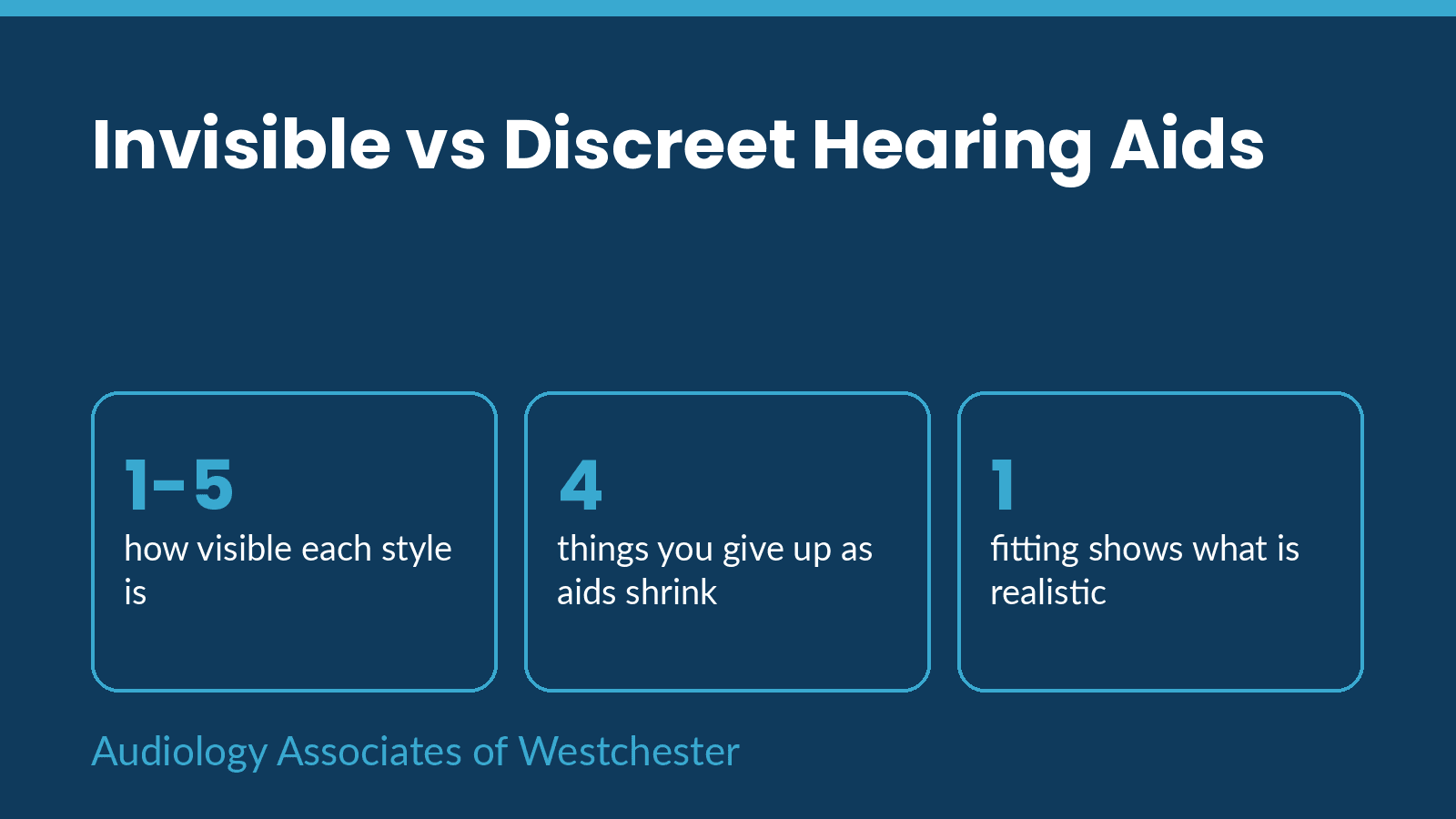
The table ranks each style from 1, hardest to see, to 5, easiest to see. The scores are our rough guide to what people notice across a table. Canal shape, hair and ear size all change what shows.
| Style | Visibility (1 to 5) | What you give up | Best for |
|---|---|---|---|
| Extended-wear (Lyric) | 1 | Subscription, professional placement, canal limits | People who want nothing visible and no daily handling |
| Invisible-in-canal (IIC), custom | 1 | Least room for features and battery | Mild to moderate loss in a roomy canal |
| Completely-in-canal (CIC), custom | 2 | Small controls and a small battery | Steady hands and mild to moderately severe loss |
| Instant-fit canal (Oticon Zeal, Signia Silk) | 2 | Part of the shell may show; small to handle | People who want rechargeable canal aids without a mold |
| Discreet receiver-in-canal (RIC) | 2 | A thin wire and a small body behind the ear | Most adults who want a small, flexible aid |
| In-the-canal (ITC) | 3 | More visible than CIC | Discreet fit with simple controls |
| Behind-the-ear (BTE) | 3 | The most visible of the common styles | Severe loss and larger controls |
The case for discreet instead of invisible
A modern receiver-in-canal aid keeps only a thin wire and a small body behind the ear, and most people never see it in conversation. It can carry a larger battery, a stronger receiver and fuller features, including a telecoil on some models. Many people who start by asking for invisible choose this style once they see it on their own ear. The deepest styles still win on looks alone, and for some people that is the right priority.
What you give up as devices shrink
Four things tend to shrink with the device. Battery size falls, so the smallest styles mostly use disposable cells. Controls get smaller and harder to handle. Features such as streaming and directional microphones have less room. And the range of hearing loss the style can cover narrows. Our guide to the types of hearing aids lays out the limits of each style.
The 2026 invisible options
HearingTracker's listings describe the Oticon Zeal and the Signia Silk Charge&Go IX as instant-fit, completely-in-canal and rechargeable. The same listing gives up to 20 hours of battery for Zeal and suggests suitability up to severe loss in its own best guess. It lists Silk for mild to moderate loss and gives two battery figures, 20 and 28 hours. Both listings say part of the device may be visible and that small size can be hard to handle with limited dexterity or vision. Independent results are limited, so we treat these as options to try, not as proven winners.
Extended-wear and custom deep styles
Lyric is placed deep in the canal by a clinician and worn continuously, with no battery for you to change, and the device is replaced on a schedule. Custom IIC and CIC shells are built from an impression of your ear. All of them depend on canal anatomy, and a check of your ears comes before any promise. We confirm with each office whether Lyric is offered at your visit.
When a bigger device is the better choice
If your hearing loss is moderately severe or worse, if you stream often, if you use loops or a telecoil, or if small parts are hard for your fingers, a discreet receiver-in-canal or a larger style may hear better than an invisible one. Wearing a device every day matters more than hiding it, because an aid in a drawer helps nobody.
What we check before we recommend a style
We start with a hearing test, then look at your ear canals, then talk about your hands, your battery routine and the places where you most want to hear. Only then do we match a style to you. See our guide to hearing aid fitting for what happens after you choose.
Book a fitting visit
Call our Harrison office at (914) 949-0034 or our Somers office at (914) 556-6720 to book a visit. Harrison is at 550 Mamaroneck Avenue, Suite 407. Somers is at 325 NY-100.
Last updated and sources
Last updated November 4, 2026. What changed: this is the first version. The 2026 device details come from HearingTracker's listings, which conflict in places.
Medical information
This page gives general information. It is not medical advice and it does not diagnose or recommend treatment. Sudden hearing loss, hearing loss in one ear, ear pain or dizziness need prompt medical care. Call Harrison at (914) 949-0034 or Somers at (914) 556-6720.
Common questions
Are invisible hearing aids really invisible?
Close to it for most wearers, since the device sits inside the canal. Someone looking straight into your ear may see a faceplate, and the amount that shows depends on your canal.
Is a receiver-in-canal aid discreet enough?
For most people, yes. Only a thin wire and a small body show behind the ear, and many people never notice it in conversation.
What do I give up with an invisible aid?
Usually battery size, control size, some features and some range of hearing loss. The smaller the device, the more you trade.
Can invisible aids be rechargeable?
Some can. HearingTracker lists the Oticon Zeal and the Signia Silk Charge&Go IX as rechargeable instant-fit canal aids. Custom IIC and CIC shells usually use disposable batteries.
Who should not choose an invisible hearing aid?
People with moderately severe or worse loss, people who stream often or need a telecoil, and people whose hands find small parts hard. A bigger style may serve them better.
How do I find out if I am a candidate?
A hearing test and an ear exam tell us. Canal size and shape decide what can fit, and a photo cannot show that.