How hearing aids work
How Do Hearing Aids Work? What the Fitting Does to the Sound
A hearing aid is a microphone, a processor and a speaker, and the fitting decides how it sounds. See what we adjust and why. Book a fitting in Westchester.
Read time: 8 min read
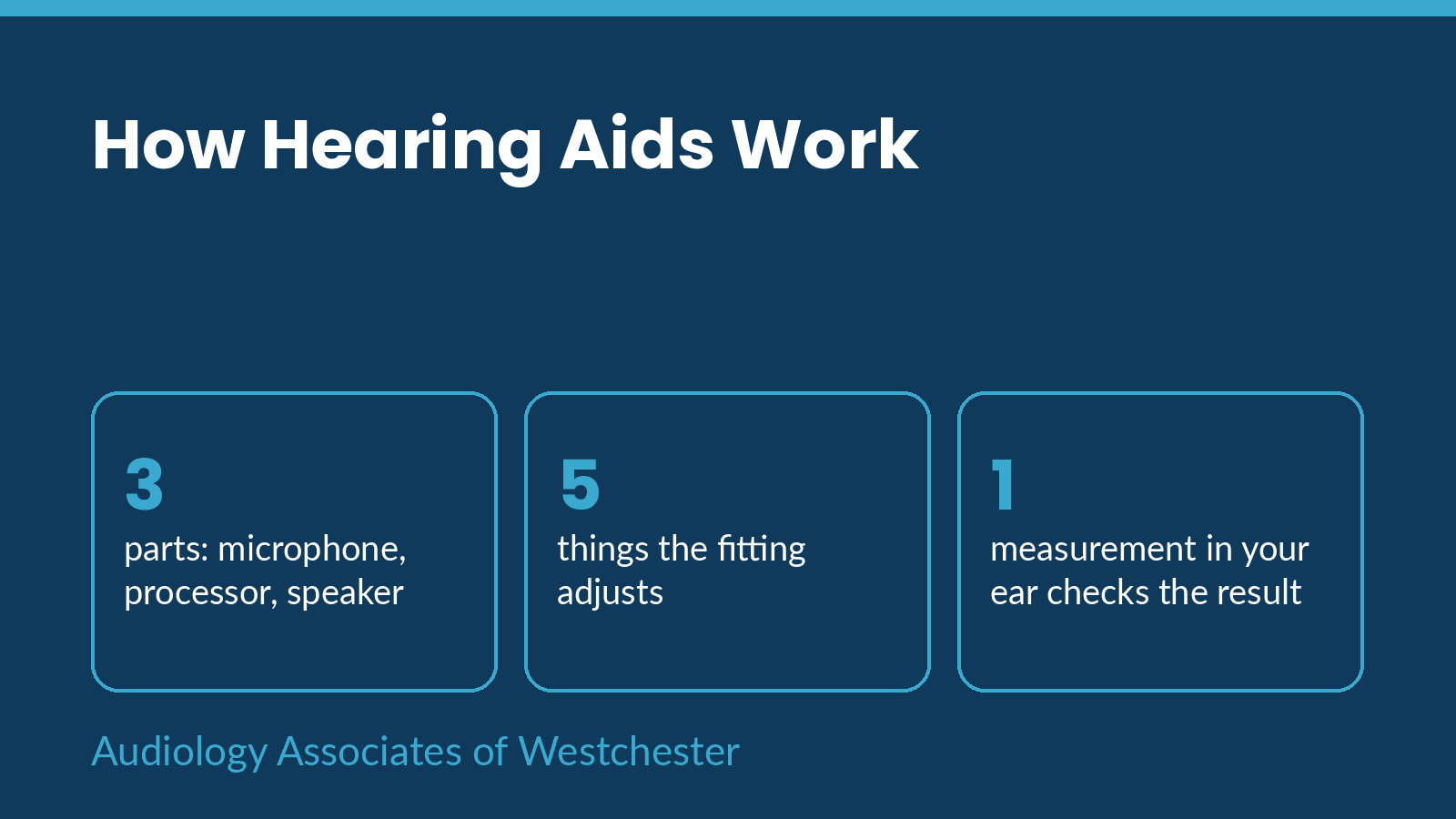
A hearing aid has three working parts: a microphone that picks up sound, a processor that reshapes it and a speaker that plays it into your ear. The parts are the same from one brand to the next. What makes one pair work for you and another disappoint is the fitting, which sets how the processor reshapes sound for your hearing test and checks the result in your ear.
Most explanations stop at the hardware. This one follows the sound through the aid and marks the point at which an audiologist changes it. If you have a pair that sounds wrong, the table shows what we can adjust. If you are about to buy one, it shows what to ask a seller to do.
“The hardware is the raw material. The fitting is what makes it yours.”
What we adjust at each stage
The table follows sound from the microphone to your ear and lists the setting we change at each point. The right setting comes from your hearing test and from measurement in your ear, not from the brand.
| Stage | What happens | What we adjust | What to ask a seller |
|---|---|---|---|
| Microphones | Pick up sound, often with more than one for direction | When and how strongly directional settings work | Is directional hearing on automatically? |
| Processor | Boosts each pitch by the amount your test calls for | Gain by pitch, compression for loud sounds | Is it set to a target from my test? |
| Noise reduction or AI | Separates speech from other sound on some models | How strongly it acts in noise | What has been tested independently? |
| Receiver and dome | Plays the sound into your ear canal | Dome or earmold style, how open the fit is | Which dome suits my loss? |
| Your ear canal | Changes the sound before it reaches your eardrum | Settings, until a probe-microphone check meets the target | Will you measure in my ear? |
Microphones: what the aid picks up
Most aids carry more than one microphone so the processor can compare where sound arrives from. Directional settings favor sound in front of you. Wax or debris in the microphone ports reduces what the aid hears, which is why cleaning is part of the routine. At the fitting we choose when directional settings turn on and how strongly.
The processor: reshaping sound for your loss
Your audiogram shows which pitches you hear least. The processor boosts each pitch by the amount your test calls for, and it compresses loud sounds so they stay comfortable. This is the main thing the fitting sets. Two people with different tests need different settings, even in the same model.
Noise reduction and AI
Many 2026 flagships add a deep neural network, a computer model trained on large numbers of sound examples to tell speech from other sounds. Makers say it lifts the voice you want and reduces other sound. Their performance claims are the companies' own, and the benefit depends on your fitting. Our guide to what AI in hearing aids actually does explains the claims, and our comparison of the fall 2026 AI hearing aids lists what each maker says.
The speaker and the fit in your ear
The speaker, called the receiver, plays the processed sound into your ear canal. A dome or earmold sets how much sound leaks out and how much stays in. An open dome feels natural but gives less low-pitch boost. A closed one gives more boost and a stronger sense of plugging. We choose the dome to match your loss.
Why we measure in your ear
The ear canal changes the sound that reaches your eardrum, and every canal differs. A thin probe microphone placed in your ear measures what the aid really delivers. We compare it with the target for your hearing test and adjust until they match. Skipping this step leaves the result to the software's prediction. See our page on hearing aid fitting.
Why a good fit still needs follow-up
The brain needs time to adjust to sounds it has not heard in years. First settings are often set a little lower, then raised as you adapt. Follow-up visits let us read the aid's logs, ask what is hard and change the settings. Our page on hearing aid adjustments explains what to expect.
Connections and Auracast
Many aids stream phone calls and television over Bluetooth, and newer models add Auracast, which broadcasts venue and TV audio to many compatible aids at once. See our guide to Auracast hearing aids for what works today.
Book a fitting visit
Call our Harrison office at (914) 949-0034 or our Somers office at (914) 556-6720 to book a visit. Harrison is at 550 Mamaroneck Avenue, Suite 407. Somers is at 325 NY-100.
Last updated and sources
Last updated November 4, 2026. What changed: this is the first version.
Medical information
This page gives general information. It is not medical advice and it does not diagnose or recommend treatment. Sudden hearing loss, hearing loss in one ear, ear pain or dizziness need prompt medical care. Call Harrison at (914) 949-0034 or Somers at (914) 556-6720.
Common questions
Do hearing aids just make everything louder?
No. They boost the pitches you hear least by more than the ones you hear well, and they keep loud sounds comfortable. That shaping comes from your hearing test.
What is real-ear measurement?
A thin probe microphone in your ear canal measures the sound the aid actually delivers. We compare it with the target for your test and adjust until they match.
Why do new hearing aids sound strange?
Your brain has to adjust to sounds it has not heard in a while. We often start settings a little lower and raise them as you adapt.
Does AI make hearing aids better?
It can help in noise on some models, but the performance claims come from the companies. A careful fitting matters more than any single feature.
Can an audiologist change a hearing aid I bought elsewhere?
Often, yes, depending on whether the device is locked to the seller. Call us and we will tell you what is possible.
How often will the aids need adjusting?
Often in the first weeks, then less. Follow-up visits are where most of the benefit gets built.