Severe hearing loss guide
Hearing Aids for Severe Hearing Loss: Power, Fitting and a Second Look
Power hearing aids, custom earmolds and when a cochlear implant evaluation makes sense for severe hearing loss. Book a second look in Harrison or Somers.
Read time: 8 min read
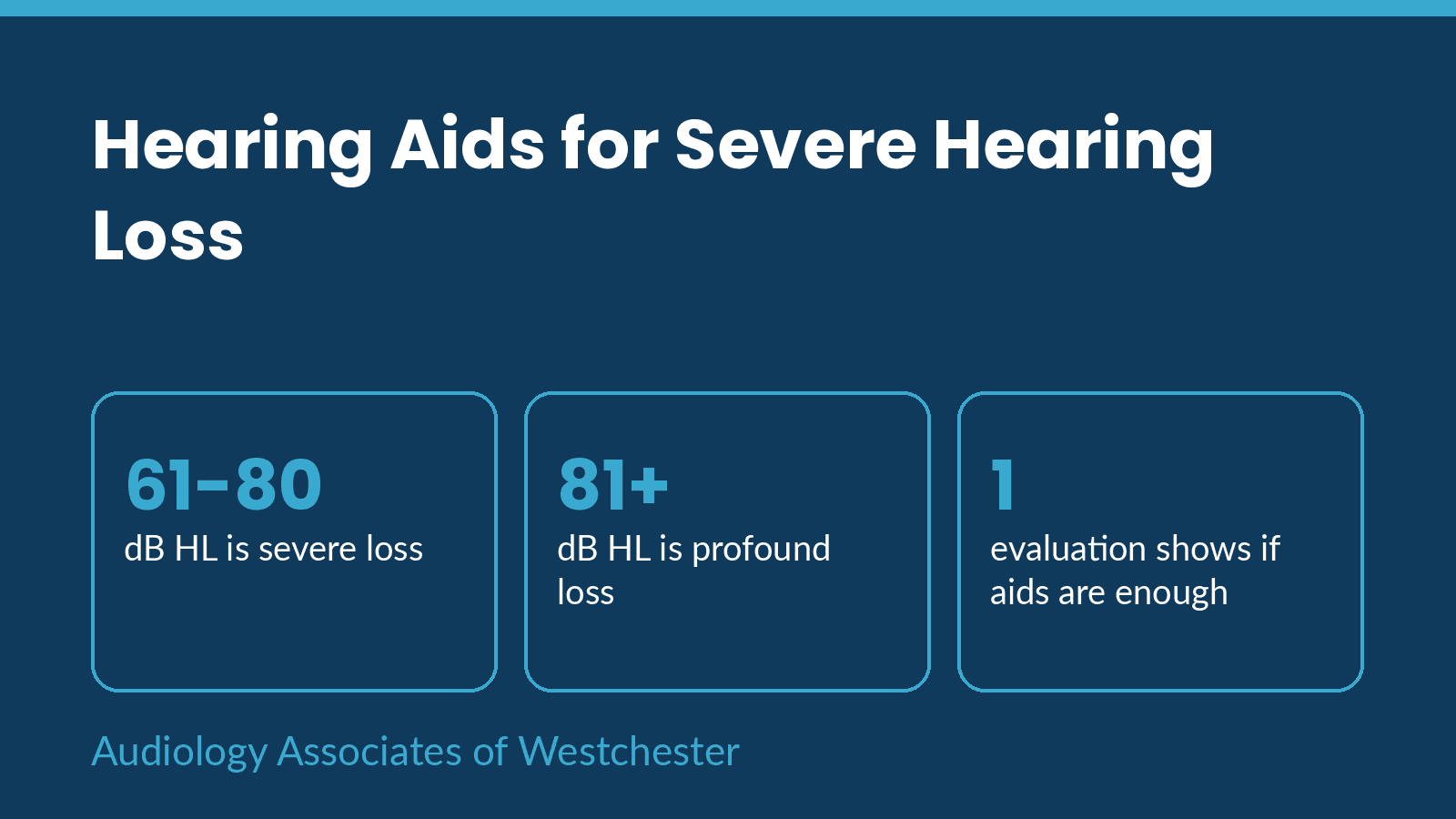
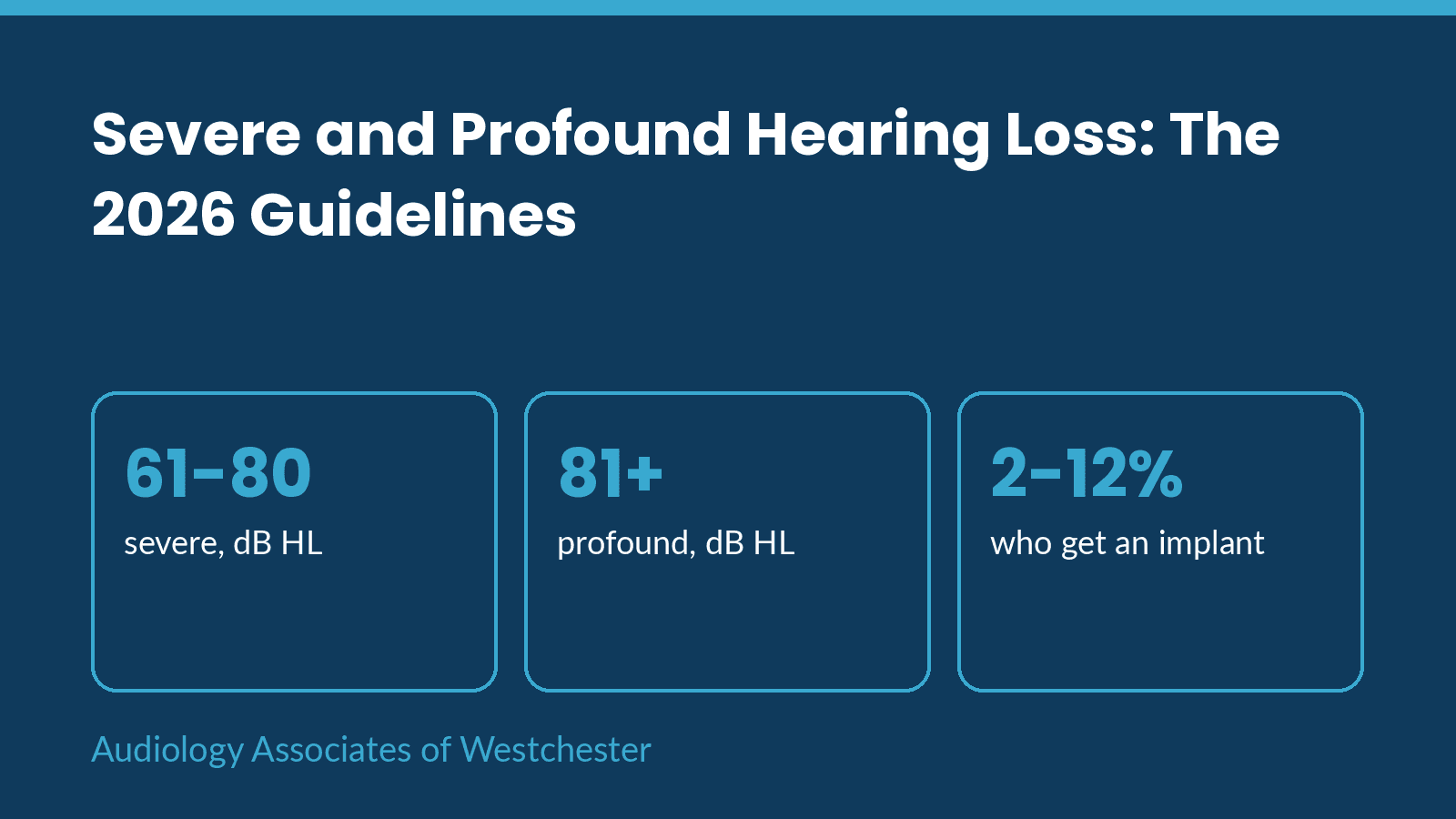
If your hearing loss is severe, meaning 61 to 80 dB HL in your better ear, a well-fitted power hearing aid can still help you a great deal. A power device needs enough output, a snug seal and careful measurement in your own ear. When even a good fit gives you volume without clear words, it is reasonable to ask for a second look, which can include a cochlear implant evaluation.
This guide is for people with severe or profound loss and for the family members who help them. It compares the three power classes, explains why a fitting like this takes more care and then describes the point at which it makes sense to ask whether aids are still the right tool. Our audiologists do cochlear implant candidacy work, activation and mapping, led by Dr. Caitlin Dold. Surgery is done by a surgeon elsewhere.
“A good power fitting asks for more care, not just more volume.”
Power classes at a glance
The table sorts the three power classes by who they suit, what the ear needs and what to watch for. Ranges differ by maker and by model, so we check the exact fitting range for the device on your quote.
| Power class | Who it tends to suit | What the ear needs | What to watch for |
|---|---|---|---|
| Power receiver-in-canal | Moderately severe to severe loss, and some profound loss on models that list it | A snug dome or custom earpiece | Wax can block the speaker, and feedback needs managing |
| Power behind-the-ear | Severe to profound loss, ears that are hard to fit, larger controls | A custom earmold in most cases | More visible than a receiver-in-canal aid |
| Super-power behind-the-ear | Profound loss, or severe loss that needs the most output | A tightly sealed custom earmold | Often fewer features than standard models |
Why the fitting takes more care
Severe loss asks a hearing aid to deliver a lot more sound than mild loss does. That makes feedback, the whistle that happens when sound leaks back to the microphone, harder to control. It also means output has to be set high enough to help and low enough to stay comfortable. In their summary of the 2026 expert guidelines, Hearing Health Matters lists verified fitting, custom earmolds, output limiting and outcome measurement as parts of good care. We build a fitting around those steps.
Power receiver-in-canal aids
These keep a small case behind the ear and a stronger speaker in the canal. They suit people who want a small device and whose ears hold a snug earpiece. Makers publish how far each model reaches. Phonak lists EON for mild through profound loss, and Oticon Reveal offers four receiver powers that cover mild through severe loss. Our job is to match your thresholds to the range for the exact model, not to rely on the brand name.
Power and super-power behind-the-ear aids
A larger case holds a stronger amplifier and a bigger battery, and a custom earmold carries the sound to your ear. These are the usual starting point for severe to profound loss, for ears that are hard to fit and for people whose fingers handle larger controls more easily. The earmold matters as much as the aid, because a good seal lets the aid deliver more sound without whistling.
Why we measure in your ear
A thin probe microphone placed in your ear canal measures what the aid really delivers. In a severe loss, the difference between what the software predicts and what the ear receives can be large. We measure at the fitting and again when settings change. See what we do at a fitting.
The second look: when aids may not be enough
A cochlear implant bypasses the damaged part of the inner ear and stimulates the hearing nerve. Consider asking about one if well-fit aids give you volume but not clear words. A common U.S. referral signal is the 60/60 rule from Zwolan and colleagues (Otology and Neurotology, 2020): an unaided average threshold of 60 dB HL or worse and an unaided word score of 60 percent or lower in the better ear. It is a reason to be evaluated, not a diagnosis. We offer an evaluation as a second look, and having one does not commit you to surgery. For the clinical detail, see our page on the 2026 guidelines for severe and profound hearing loss and our guide to when hearing aids are no longer enough.
For family members
If you are reading this for a parent or a spouse, the signs worth watching are heavy lip reading, trouble in quiet rooms, giving up on the phone and turning the aids up without getting clearer speech. Bring them to a visit with their aids, and bring a list of the situations that are hardest. Our guide to signs someone you love needs help can help you start the conversation.
What we cannot promise
No hearing aid restores normal hearing, and we do not promise any particular result. Outcomes depend on how much hearing nerve function remains, how long the loss has been present and how well the fitting is supported. We will tell you plainly when a device is not giving you enough.
Book a visit
Call our Harrison office at (914) 949-0034 or our Somers office at (914) 556-6720 to book a visit. Harrison is at 550 Mamaroneck Avenue, Suite 407. Somers is at 325 NY-100.
Last updated and sources
Last updated November 4, 2026. What changed: this is the first version.
Medical information
This page gives general information. It is not medical advice and it does not diagnose or recommend treatment. Sudden hearing loss, hearing loss in one ear, ear pain or dizziness need prompt medical care. Call Harrison at (914) 949-0034 or Somers at (914) 556-6720. Cochlear implant candidacy is decided at an evaluation.
Common questions
What is the most powerful hearing aid?
Super-power behind-the-ear aids give the most output, but the right device matches your thresholds and stays comfortable at loud levels. We choose it by testing.
Can a receiver-in-canal aid help severe loss?
Yes, on models with power receivers and a snug fit. Makers list the range for each model, and we check it against your test.
When should I ask about a cochlear implant?
Ask if well-fit aids give you volume but not clear words. The 60/60 rule is a common U.S. signal, and candidacy is decided at an evaluation.
Will more power harm my hearing?
Output that is set badly can be uncomfortable or unsafe. We limit output and verify it in your ear, and we ask you to tell us if loud sounds are ever painful.
Does an evaluation commit me to surgery?
No. An evaluation tells you whether you are a candidate. The decision about surgery is yours and comes later.
What can help me with phone calls?
Ask about streaming, a telecoil, captioned phone services and a clip-on microphone. If clarity stays low, ask for an evaluation.