Hearing aids for seniors
Hearing Aids for Seniors: A Guide for Families
A family guide to hearing aids for seniors: how to start the talk, what the dementia research says and what a visit looks like in Westchester. Book now.
Read time: 8 min read
This guide is for the family. Most older adults do not decide alone to get hearing aids. A daughter, a son or a spouse notices first, and the hard part is the talk. The steps below help you start it, prepare for the visit and understand what the research does and does not say.
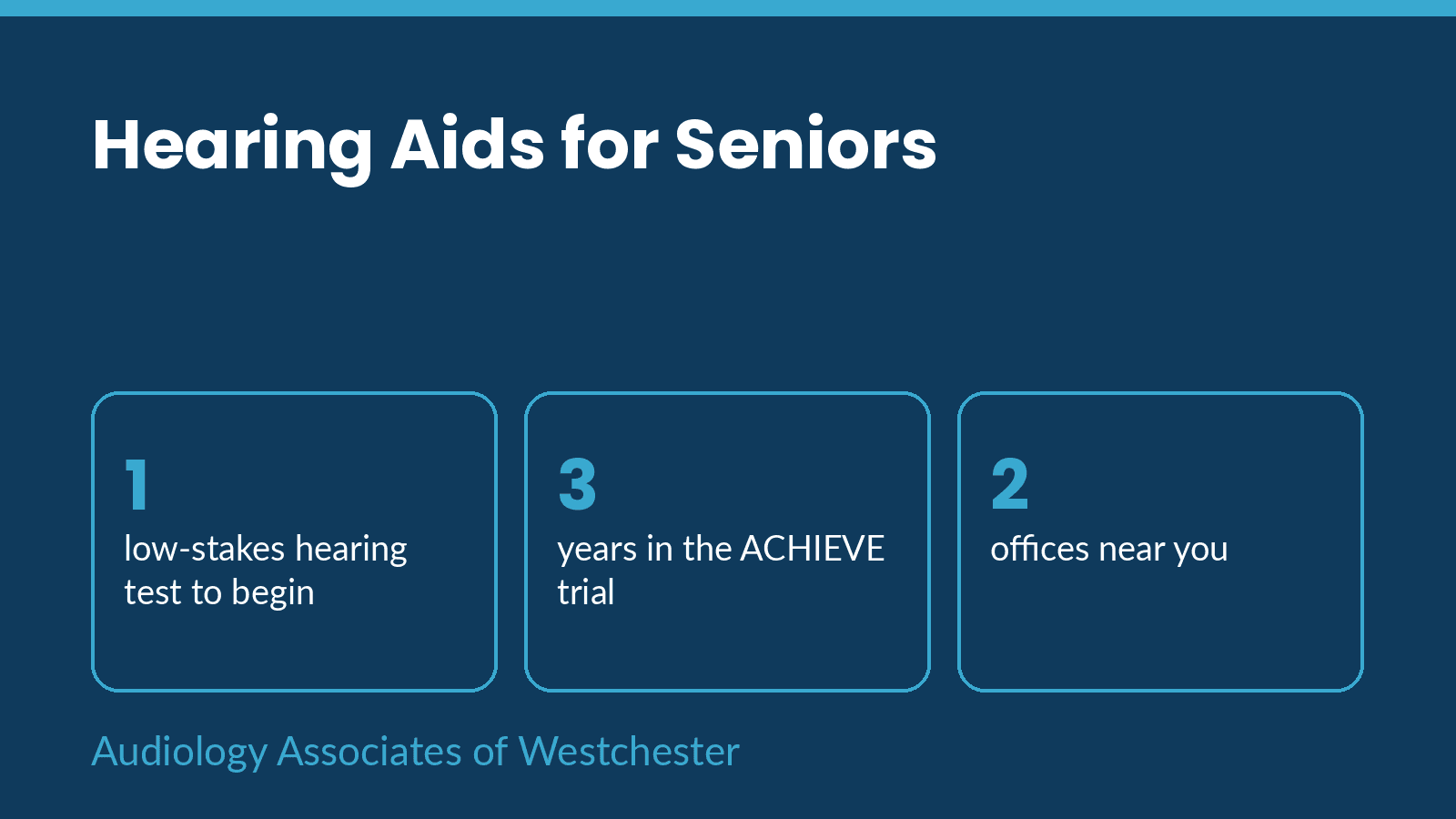
Hearing aids do not need to be a big decision at the first step. A hearing test is a low-stakes way to learn what is happening. If a test shows loss, you can choose aids at a pace that suits your parent. Our guide to the signs you need hearing aids lists what families often notice first.
“One calm talk works better than three pushy ones.”
Start the talk, step by step
The table gives a plan from the first mention to the first visit. Go at your parent's pace. One calm talk works better than three pushy ones.
| Step | What to do | Why it helps |
|---|---|---|
| 1 | Name one example you noticed, such as the TV volume | A concrete example feels less like blame |
| 2 | Ask what is hard, and listen | It puts your parent in charge |
| 3 | Offer a hearing test as a check, like a vision check | A test is low-stakes |
| 4 | Offer to drive and to sit in if wanted | It removes obstacles |
| 5 | Go to the follow-up visit | It builds trust and keeps the aids in use |
What the dementia research says
Large studies link untreated hearing loss with a higher chance of dementia, and families often ask if hearing aids prevent it. The ACHIEVE trial in The Lancet in 2023 followed 977 adults aged 70 to 84 for three years. It found no slowing of cognitive decline in the whole group. In a pre-planned higher-risk subgroup, decline was slower. This is encouraging but it is not proof that hearing aids prevent dementia, and we do not promise that. The clearer reason to treat hearing loss is that your parent hears family, doctors and daily life better.
What a visit looks like
We start with a full hearing test and a talk about what is hard. We explain the results in plain words. If aids make sense, we choose two or three that suit the hearing test, the hands and the routine, then fit and measure them in the ear. Family members are welcome. Our page on hearing aid fitting explains each step.
Choosing for hands, eyes and routine
Rechargeable aids suit many seniors who find tiny batteries hard. Others prefer a style that is easy to place, or one with larger controls. See our guide to rechargeable hearing aids and our page on types of hearing aids.
Supporting the first weeks
Aids take time. Sounds seem loud at first, and the brain adapts over weeks. Help with the daily routine, such as cleaning, charging and wearing them for a few hours at a time. Come to the follow-up visit if your parent wants you there.
Book a visit
Call our Harrison office at (914) 949-0034 or our Somers office at (914) 556-6720 to book a visit. Harrison is at 550 Mamaroneck Avenue, Suite 407. Somers is at 325 NY-100.
Last updated and sources
Last updated November 4, 2026. What changed: this is a new page. Source for the research summary: Lin and colleagues, The Lancet, 2023 (ACHIEVE trial).
Medical information
This page gives general information. It is not medical advice and it does not diagnose or recommend treatment. Sudden hearing loss, hearing loss in one ear, ear pain or dizziness need prompt medical care. Call Harrison at (914) 949-0034 or Somers at (914) 556-6720.
Common questions
My parent refuses to get hearing aids. What helps?
A low-stakes hearing test often does. Pressure rarely works.
Do hearing aids prevent dementia?
No one has shown that. The ACHIEVE trial found no slowing in the whole group and slower decline in a higher-risk subgroup.
Can I come to the visit?
Yes, if your parent wants you there.
What if my parent has trouble with small batteries?
Rechargeable aids often help. We let you test the controls.
How long until my parent gets used to the aids?
Often several weeks. Follow-up visits help.
Do you serve both Harrison and Somers families?
Yes. Both offices see older adults and their families.