Hearing aid prices
Hearing Aid Prices in 2026: What You Pay, and What You Are Paying For
Compare what hearing aids cost by channel and level, see dated survey figures and learn what to ask before you buy in Westchester. Book a visit.
Read time: 8 min read
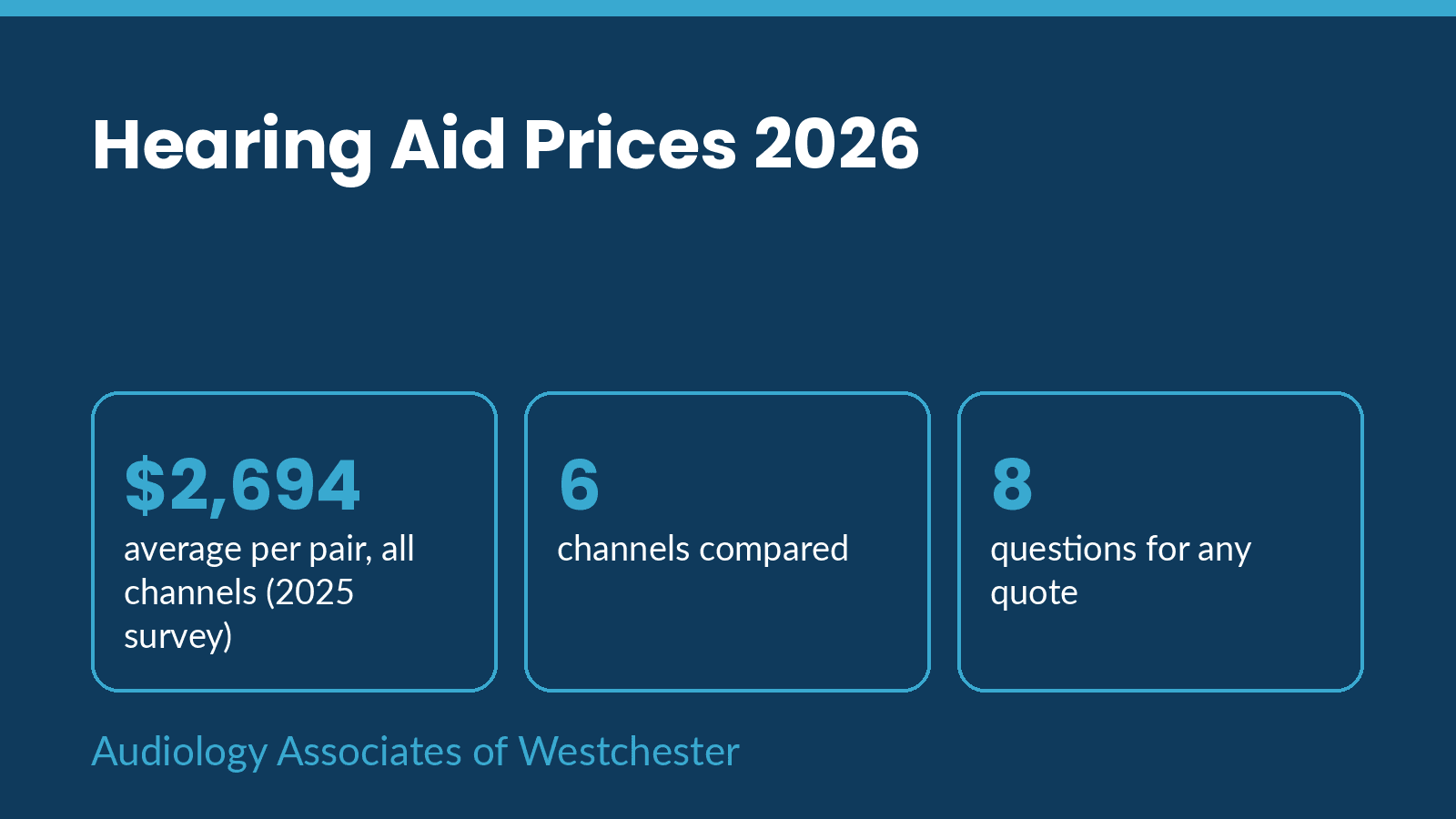
Hearing aids cost from under $100 for some over-the-counter devices to well over $8,000 a pair for premium fitted aids. In HearingTracker's 2025 survey of U.S. buyers, the average across all channels was $2,694 a pair and the median was $1,999. This page shows the survey figures by channel and technology level, and it gives you the questions that make any two quotes comparable.
We do not list our own prices on this page. A fair price depends on your hearing test, the technology level that suits your life and the service you need, so we quote after the test. We would rather you compare quotes with a checklist than with a headline number. For our local view, see our guide to hearing aid cost in Westchester.
“Compare quotes with a checklist, not a headline number.”
What people paid in 2025
The table shows what U.S. buyers reported paying in HearingTracker's 2025 survey, by channel. It covers 879 pair purchases with a reported price, and it excludes VA purchases. The figures are survey data, last updated July 31, 2026. They are not quotes from us or from anyone else.
| Channel | Average per pair | Median per pair | What to check |
|---|---|---|---|
| All channels | $2,694 | $1,999 | Averages hide wide ranges |
| Prescription, private pay (includes warehouse clubs) | $3,432 | Not stated | Ask what service is bundled |
| Warehouse club | $1,674 | $1,600 | Ask about fitting method and follow-up |
| Online with professional fitting | $2,643 | Not stated | Ask who adjusts the aids |
| Online without professional fitting | $922 | Not stated | You set up and adjust them yourself |
| Over-the-counter | $502 | $200 | For mild to moderate loss in adults |
Price by technology level
HearingTracker's survey also split prices by technology level. For private-pay buyers, the average was $2,150 a pair for low-end aids, $4,018 for mid-range and $5,225 for top-end. For buyers with insurance, it was $1,481, $1,970 and $3,531. The survey page gives two slightly different overall ranges, so treat the top and bottom of any range as rough. Clinic price lists in 2026 commonly run from about $1,000 to $2,000 per device for entry-level aids, about $2,000 to $3,000 for mid-level and about $3,000 to $4,000 or more for premium. A pair is two devices. These are market ranges, not our prices.
Does a higher price buy better results?
Not reliably. A two-site randomized trial of 245 adults aged 55 and older with mild to moderate loss found no significant outcome difference between high-end aids at roughly $4,400 a pair and low-end aids at roughly $1,100 a pair. The same trial found that audiologist-fitted aids beat over-the-counter aids on its main measure. The service mattered more than the price tier (Wu and colleagues, JAMA Otolaryngology, 2025).
What a price should include
Ask whether the quote includes the hearing test, the fitting, real-ear measurement, follow-up visits, cleaning and adjustments, the warranty, and loss and damage cover. Some providers bundle all of these. Others charge for each visit. HearingTracker describes comprehensive local support as the gold standard, and either model can be fair when it is clear. Ask for every term in writing.
Why a technology level costs more
A higher level usually adds processing that helps in harder listening rooms, such as noisy restaurants. Whether your life includes those rooms is the real question. We start from your hearing test and your routine, then compare two or three levels with you in the office. Our page on brands compared and our guide to AI in hearing aids explain what each level adds.
Insurance and employer benefits
Original Medicare does not generally cover routine hearing aids. Some Medicare Advantage plans, employers and unions include a hearing benefit, and the amount varies a great deal. Check your plan before you shop. Our guides on insurance, employer and union benefits, and payment plans explain how to read yours.
Book a visit
Call our Harrison office at (914) 949-0034 or our Somers office at (914) 556-6720 to book a visit. Harrison is at 550 Mamaroneck Avenue, Suite 407. Somers is at 325 NY-100. A hearing test comes first, and we give you an itemized quote after it.
Last updated and sources
Last updated November 4, 2026. What changed: this is a new guide. Sources: HearingTracker, What is the true cost of hearing aids in 2026 (survey figures, updated July 31, 2026); Wu and colleagues, JAMA Otolaryngology 2025.
Medical and financial information
This page gives general information. It is not medical advice or financial advice. Prices change, so confirm any price with the seller in writing.
Common questions
How much do hearing aids cost?
In HearingTracker's 2025 survey, the average across all channels was $2,694 a pair. Prescription aids averaged $3,432 a pair and over-the-counter aids $502.
Why do hearing aids cost so much?
They are small computers made in low volumes, and the price also pays for a licensed professional to fit and adjust them.
Does Medicare pay for hearing aids?
Original Medicare does not generally cover routine hearing aids. Some Medicare Advantage plans do.
Are warehouse club hearing aids the same?
They can use the same technology level with a different service model. Ask what fitting and follow-up are included.
Is it cheaper to buy one hearing aid?
One costs less up front, but most people with loss in both ears do better with two. A hearing test shows what you need.
What do you charge?
We quote after your hearing test, itemized. Call either office and we explain each line.