Reader's guide
Do Hearing Aids Prevent Dementia? A Reader's Guide to the 2026 News
A 2026 Neurology study linked hearing aids to lower dementia risk. Learn what an association is, what a trial shows, and how to read the headlines.
Read time: 8 min read
Every few months a headline links hearing aids to dementia. Some say hearing aids lower the risk. Some say they do not help memory. Both can come from the same study. This page is a guide to reading those stories. It explains what an association is, what a trial is, and what each recent study can and cannot tell you.
The short answer: no study has shown that hearing aids prevent dementia. The best recent evidence shows a link, not a cause. That is a smaller claim than the headlines suggest, and it is still worth understanding.
“A link is not a cause. The useful question about any headline is what kind of study it came from.”
Two kinds of evidence
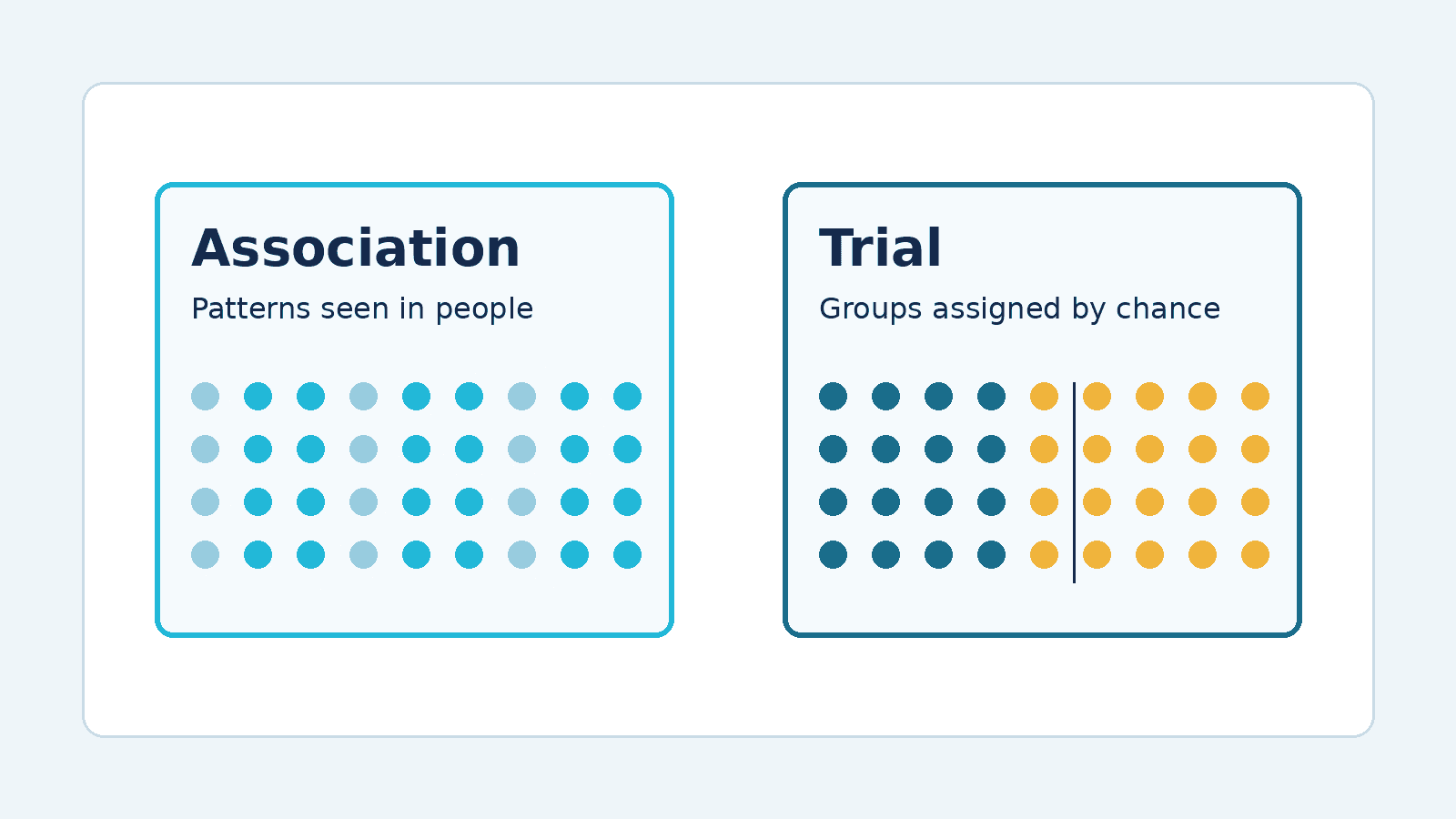
An observational study watches what happens to people and looks for patterns. It can show an association: people who did one thing also tended to have a certain outcome. It cannot show why. People who get hearing aids may differ from people who do not in income, health, education and how much they see doctors. Researchers adjust for what they can measure, but some differences stay hidden. A randomized trial assigns people to groups by chance. If the groups start out alike, a difference at the end is more likely to come from the treatment itself. Trials are slower and costlier, so there are fewer of them. When the two kinds of evidence disagree, a well-run trial usually carries more weight on the question of cause.
What the January 2026 Neurology study did
On January 14, 2026, the journal Neurology published a study by researchers including Joanne Ryan of Monash University in Melbourne. It used data from an earlier aspirin study of older Australians. The analysis included 2,777 adults with an average age of about 75. None had dementia at the start, all reported moderate hearing loss, and none had used hearing aids before. Of them, 664 were prescribed hearing aids. The group was followed for seven years with a yearly test of memory, language and thinking speed. The researchers set the analysis up to mimic a trial, a method called target trial emulation. It still used existing data, not random assignment. The authors say residual confounding cannot be ruled out, and they conclude that long-term randomized trials are justified. Hearing loss in the study was self-reported. The comparison is between people prescribed hearing aids and people not prescribed, and how often people used the aids was reported separately.
What it found
Of the 2,777 people, 117 developed dementia. After adjustment, about 5 percent of those prescribed hearing aids developed dementia over seven years, compared with about 8 percent of those not prescribed. The journal abstract gives 5.0 and 7.5 percent. The authors report this as a 33 percent lower risk. That figure is a relative difference. It is not a drop of 33 points. It means the first group's risk was about two thirds of the second group's. Memory and thinking scores did not differ between the groups. For the wider outcome of cognitive impairment, which includes decline as well as dementia, the estimates were about 36 percent and 42 percent, a risk ratio of 0.85 whose confidence interval just reaches 1.00. Lower dementia risk was linked to more frequent use of the aids. Most people in the study were healthy with strong thinking skills at the start, so the results may not apply to people with poorer health or existing memory problems.
Why the two results sit oddly together
A reader may ask how fewer people could develop dementia when test scores were the same. One of the study's authors called the gap unexpected. A possible reason she gave is that most people began with good thinking skills, which left little room for scores to improve. That is a suggestion, not a finding. The study does not explain it, and we do not either. Press materials from the American Academy of Neurology say the study does not prove that hearing aids reduce the risk of dementia and only shows an association. The lead author's own wording is that the findings suggest hearing aid use may lower the risk, and that further studies are needed.
What a trial found: ACHIEVE
ACHIEVE is the best-known trial on this question. The Lancet published it on July 17, 2023. It enrolled nearly 1,000 adults aged 70 to 84 at four US sites. Half received hearing aids and instruction in using them. The other half took a healthy-aging education program. Both groups were followed for three years, with thinking tests at the start and each year. Across all participants, the rate of cognitive decline did not differ between the groups. In one subgroup, adults recruited from a long-running heart-health study who had a higher risk of dementia, those with hearing aids had almost 50 percent less decline than the education group, according to the NIH summary. That subgroup result came with a caution: the benefit showed only in the higher-risk group, not the whole sample. The lead researcher advised that older adults have their hearing checked regularly until more is known. Putting the two side by side: in both designs the average thinking scores were flat. The Neurology study found fewer dementia diagnoses among those prescribed aids. ACHIEVE found a difference only in a subgroup. Neither is proof that hearing aids prevent dementia.
Where the Lancet Commission fits
The Lancet Commission on dementia prevention, intervention and care published an update on July 31, 2024. It lists 14 risk factors that it calls potentially modifiable, and estimates that eliminating all of them could potentially prevent 45 percent of future dementia. Hearing loss is one of the 14. A summary published by CIICA quotes the Commission as putting hearing loss at 7 percent among midlife risks, and says the evidence that treating hearing loss lowers dementia risk is now stronger than in the Commission's earlier report. That is a statement about population risk, not about what a hearing aid will do for one person. A risk factor is something linked to a condition. It does not mean that removing it removes the condition.
One more 2026 analysis
On June 9, 2026, Cell Reports Medicine published an analysis that pooled 61,089 hearing-impaired adults aged 55 and older from seven ageing cohorts in 33 countries. It reported about 9 percent lower risk of probable dementia among hearing aid users than non-users, and about 14 percent lower among those who reported good hearing improvement. Those who reported poor improvement saw no significant reduction. The researchers stressed that the study is observational and cannot prove cause. One of the authors said the benefit is not simply about wearing a device. What may matter is whether the aid improves hearing in daily life.
Five questions for any headline
Ask what kind of study it was, and whether people were assigned by chance. Ask how many people it followed and for how long. Ask what the comparison group did. Ask whether the result is an absolute difference or a relative one. Ask what the authors themselves say it does not show. The table below applies these to the studies in this guide.
| Study | Design | What it can show | What it cannot show |
|---|---|---|---|
| Neurology, January 2026 (Monash University) | Observational, 2,777 Australians, average age about 75, followed 7 years, analysis built to mimic a trial | An association: about 5 percent vs about 8 percent developed dementia. Memory and thinking scores did not differ | That hearing aids prevent dementia. Residual confounding cannot be ruled out, per the authors |
| ACHIEVE, The Lancet, July 2023 | Randomized trial, nearly 1,000 adults aged 70 to 84, 3 years, four US sites | No overall difference in cognitive decline. Almost 50 percent less decline in a higher-risk subgroup | A benefit for everyone. The subgroup result held only in the higher-risk group |
| Cell Reports Medicine, June 2026 | Pooled observational analysis, 61,089 adults aged 55 and older, 7 cohorts in 33 countries, about 6.5 years | About 9 percent lower probable dementia risk among users, and about 14 percent with good reported improvement | Cause. The researchers state it is observational |
What this means for you
You do not need a dementia study to decide to get your hearing tested. Hearing well makes conversation easier, and untreated hearing loss can make listening tiring. Our page on listening fatigue explains that side. If you wear hearing aids, the studies suggest that a fit that helps you hear in daily life matters more than owning the device. A fitting with real-ear measurement and follow-up visits is how that happens. If you are in Westchester and you worry about memory, a hearing test is a reasonable first step, and it is not a memory test. Our page on hearing tests and cognitive screening explains how the two differ. If you hold Medicare, open enrollment runs through December 7, 2026, and our Medicare page explains how to read the hearing lines of your plan.
Status and last update
Last updated October 16, 2026. Change note: this is the first version. We will revise it when a new trial or analysis is published, or when the Neurology authors release more detail. Sources are listed at the end of this page.
Medical information notice
This page is general education and is not medical advice. It does not claim that hearing aids prevent, delay or treat dementia. If you or a family member has memory concerns, talk with a doctor. To book a hearing test at our Harrison or Somers office, call (914) 949-0034.
Common questions
Do hearing aids prevent dementia?
No study has shown that. The 2026 Neurology study found an association between a hearing aid prescription and lower dementia risk, and its authors say it does not prove cause. ACHIEVE, a randomized trial, found no difference overall.
What does 33 percent lower risk mean?
It is a relative figure. About 5 percent of those prescribed hearing aids developed dementia over seven years, against about 8 percent of those who were not. The first number is about two thirds of the second. It is not a 33 point drop.
Why did memory scores not differ if dementia was lower?
The study does not say. One author suggested that most people began with good thinking skills, so scores had little room to improve. That is a possible reason, not a finding.
What is the ACHIEVE trial?
ACHIEVE is a randomized trial of nearly 1,000 adults aged 70 to 84, published in The Lancet in 2023. Hearing aids and instruction were compared with a healthy-aging program over three years. Overall there was no difference, and a higher-risk subgroup showed almost 50 percent less decline.
What is the difference between an association and a trial?
An association means two things tend to occur together. A randomized trial assigns people by chance, which makes a difference in outcome more likely to come from the treatment. Trials give stronger evidence about cause.
Should I get hearing aids to protect my memory?
The evidence does not support that promise. The better reason is to hear well in daily life, which is what the research points to. A hearing test is the first step, and it tells you whether hearing aids are worth considering.
Sources and further reading
- Newswise (American Academy of Neurology): Hearing aid prescriptions not associated with changes in memory and thinking
- ScienceDaily: Hearing aids and dementia risk (Neurology 2026)
- Neurology 2026;106(3): Treating hearing loss with hearing aids for the prevention of cognitive decline and dementia (abstract summary via Aga Khan University)
- NIH Research Matters: Hearing aids slow cognitive decline in people at high risk (ACHIEVE)
- Alzheimer Europe: 2024 Lancet Commission on dementia risk reduction
- CIICA: 2024 update of Lancet Commission on dementia strengthens case for addressing hearing loss
- HKUMed: Effective use of hearing aids may help reduce dementia risk (Cell Reports Medicine, June 2026)