Research explained
Tinnitus and family history: how precision care uses what runs in your family
New gene research links tinnitus to inherited hearing loss. See how family history shapes a tinnitus plan at our Westchester offices.
Read time: 3 min read
Your family story shapes your hearing care. A new gene study shows why. In some families, tinnitus came first and measurable hearing loss followed years later. If hearing loss runs in your family and you have tinnitus, tell us. We use that detail to choose tests, set a baseline and plan follow-up.
Below, we explain the research in plain language: what the team did, what it found, and what it does not show. This page is accurate as of October 12, 2026.
“In some families, tinnitus came first and measurable hearing loss followed years later.”
What the research says
Zhang and colleagues screened 83 unrelated Chinese families with inherited, non-syndromic hearing loss. Nine families carried POU4F3 changes. The 35 people with those changes all had hearing loss. Tinnitus occurred in 21 of them. Among 20 with enough records, 9 noticed tinnitus before any measurable drop in hearing. The lead time ran from 0 to 27 years. For the full breakdown, read our companion CHC article on the POU4F3 finding. Keep the limits in view. The families came from one referral hospital in China. Do not carry those rates over to other groups. Most tinnitus in the general public has no known genetic cause.
How we use family history in a tinnitus plan
Precision care means we fit the plan to what we learn about you. Family history helps in four ways. None of these steps needs a gene test. They need careful listening and good records.
| Question we ask | Why it matters | What we may do |
|---|---|---|
| Did parents or siblings lose hearing early? | Points toward an inherited pattern | Test more thoroughly and plan repeat tests |
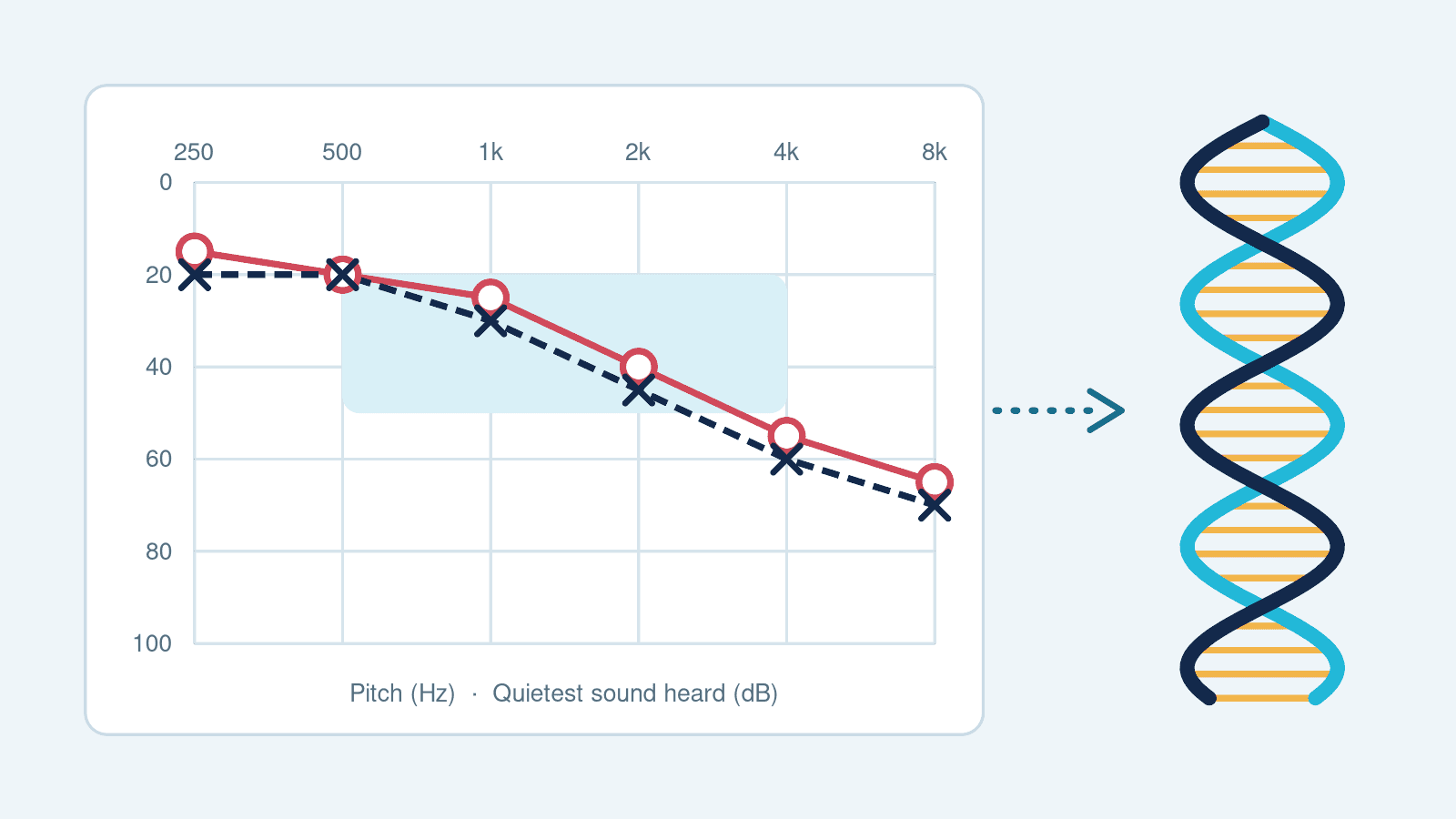
| What pitches are affected? | Inherited loss often starts at higher pitches | Look closely at high-pitch hearing |
| Did tinnitus start before hearing changed? | May be an early sign in some families | Set a baseline and track change over time |
| Who in the family has tinnitus? | Shows if the pattern repeats | Share findings with your physician, and refer to a genetics professional if the picture fits |
Where treatment fits
Tinnitus care does not wait for a genetic answer. If tinnitus bothers you, we can start sound-based tools, counseling and hearing care now. Our recent notes on sound therapy through hearing aids and on the prestin biomarker research show where the science is heading. For options we offer today, see tinnitus management and Lenire for tinnitus. If a family pattern is likely, an early baseline matters more. A record from today lets us spot small shifts later. Our article on precision hearing care and the audiogram explains how we read those records. We are also following the October 2026 genome-wide studies of hearing loss (EML6, SPTBN1, ARHGEF28, EYA4) that point the same way. Each study sharpens the picture without replacing a hearing test.
What this means for you
If hearing loss runs in your family and you have tinnitus, book a visit. Bring what you know: who lost hearing, and about when. We will test, record and plan. If your history suggests an inherited cause, we will explain how to reach a genetic counselor through your physician. Book a tinnitus evaluation in Harrison or Somers.
Status and last update
Last updated October 12, 2026. Change note: this is the first version. We will update this page if the final paper, replication studies or clinical guidance change the picture. Sources are listed at the end of this page.
Medical information notice
This article explains published research for general education. It is not medical advice and it does not diagnose any condition.
Common questions
Do you offer genetic testing for hearing loss or tinnitus?
No. We do not offer POU4F3 testing or other gene tests. We can refer you onward when your history calls for it.
Does a gene change mean I have a diagnosis?
No. A clinician has to read a result next to your hearing tests and family history. Some changes have unclear meaning.
Is my tinnitus likely genetic?
Probably not. Most tinnitus has no single genetic cause. The risk of an inherited cause rises when close relatives lost hearing young.
Should I look at my own DNA report for hearing genes?
Please talk with a genetics professional first. Raw results are easy to misread.
What should I bring to my visit?
Bring family details on hearing loss, any old hearing tests, and a list of your medicines. Note when your tinnitus began.
How often should I recheck my hearing?
It depends on your history. See how often adults should get hearing checked. With a family pattern, we may suggest closer follow-up.
Get one email if precision hearing care research moves.
We will write once if new research changes what this page says. We will send nothing else.