Plain-language guide
SPI-1005 and Sudden Hearing Loss: An Award, Not an Approval
SPI-1005 won an AAO-HNS award for Meniere's data and is not approved. What the trial shows and why sudden hearing loss still needs a doctor today.
Read time: 6 min read
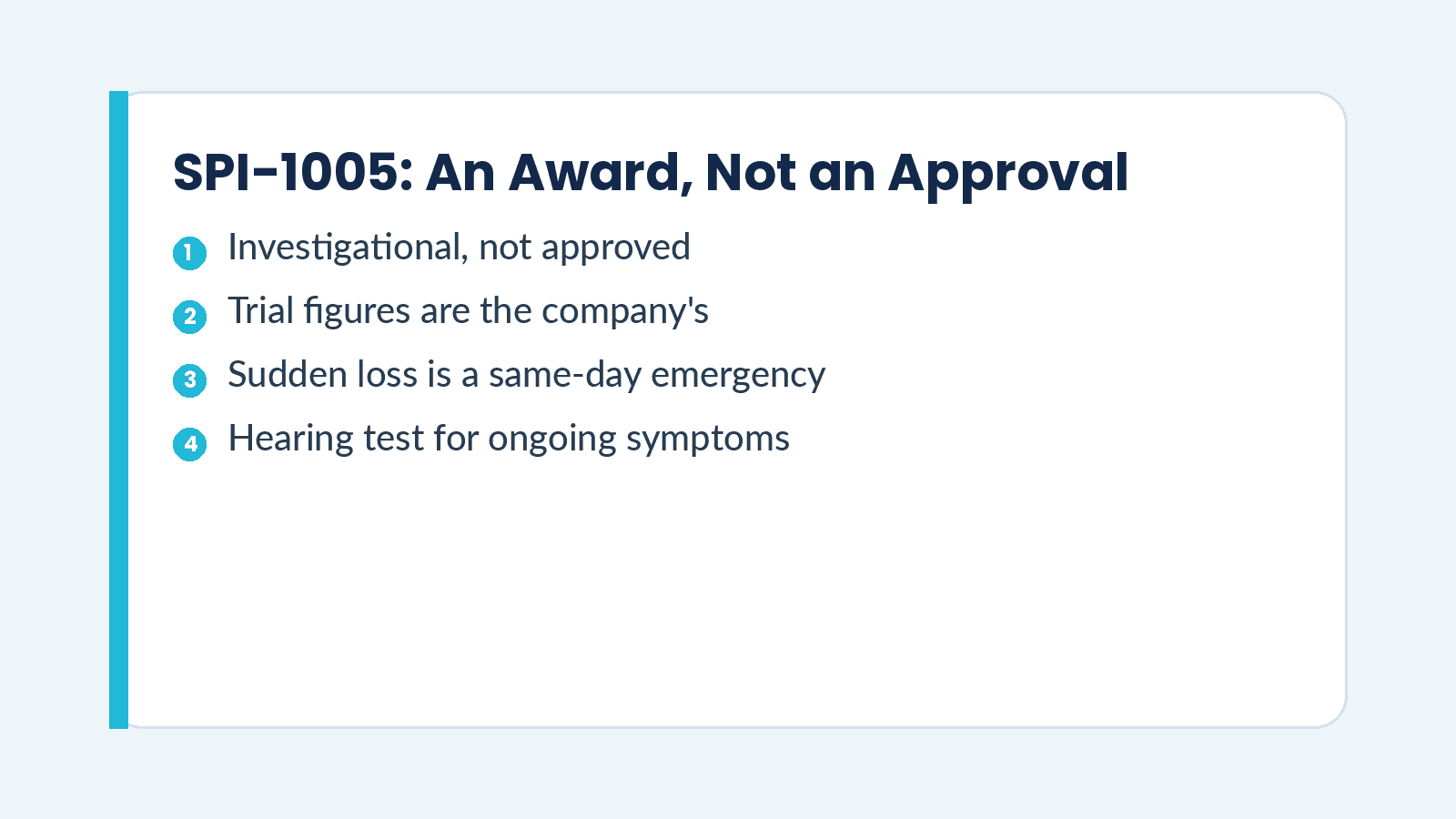
A headline this week says an experimental drug for inner ear disease won a top award. If you have sudden hearing loss or Ménière's disease, it is natural to ask whether help is near. The honest answer is that SPI-1005 is not approved, no one can prescribe it, and sudden hearing loss still needs a doctor on the same day. This page explains the news and what to do, from the audiologists at Audiology Associates of Westchester.
What was announced
“An award is not an approval. If your hearing drops suddenly, call a doctor today.”
On October 19, 2026, Sound Pharmaceuticals said its abstract on SPI-1005 won Best in Scientific Orals at the annual meeting of the American Academy of Otolaryngology-Head and Neck Surgery in Los Angeles. SPI-1005 is an oral capsule that contains ebselen. The abstract re-analyzed a Phase 3 trial in people with definite Ménière's disease, which is an inner ear disorder with vertigo attacks, ringing, fullness and hearing loss. The company reports that more ears gained at least 10 decibels with the drug than with placebo at days 28, 56 and 84.
What the Phase 3 trial reported
The trial, called STOPMD-3, enrolled 221 adults at 11 sites. Sound Pharma announced the main results on December 10, 2024. People took SPI-1005 or a placebo twice a day for 28 days and were checked through day 84. At day 84, the company says 57.9 percent of the drug group had gained at least 10 dB at one low pitch, against 36.5 percent on placebo. The table below shows all three company-reported goals. The figures are the company's, and we found no peer-reviewed paper with full results in the releases we read.
How to read the SPI-1005 numbers
The company says the FDA gave SPI-1005 Fast Track and, in December 2025, Breakthrough Therapy designation for hearing loss in Ménière's disease. Those labels are meant to speed review of a promising drug. They are not approvals. The company says it is working toward a New Drug Application. Until the FDA acts, SPI-1005 is investigational and cannot be prescribed. If you have Ménière's, an ear, nose and throat doctor can tell you whether any trial applies to you.
The sudden hearing loss claim
Sound Pharma says the new analysis supports future study in sudden sensorineural hearing loss, which it describes as a similar one-sided, low-to-mid pitch loss. That is the company's interpretation. The analysis did not test the drug in people with sudden hearing loss. A separate trial would have to do that. This matters because the idea that a pill may someday help should never delay care today.
If you lose hearing suddenly
The National Institute on Deafness and Other Communication Disorders calls sudden deafness a medical emergency. It says treatment started more than two to four weeks after onset is less likely to restore hearing, and that steroids work best when started early. About half of people recover some or all hearing on their own, but no one can tell in advance who will. See a doctor the same day. Our page on [why you should not wait on sudden hearing loss](/sudden-hearing-loss-why-not-wait) and our [sudden hearing loss guide](/hearing-loss/sudden-hearing-loss) explain the steps. If ringing starts or worsens suddenly, read our page on [sudden or worsening tinnitus](/how-we-can-help/tinnitus-management/sudden-or-worsening-tinnitus).
Ménière's disease and the audiologist's role
Ménière's is diagnosed by an ear, nose and throat doctor. Our part is hearing care. We test hearing and record changes over time, which helps your doctor see the pattern. We also manage tinnitus and fit hearing aids, which the NIDCD recommends for the hearing loss. Dizziness with ringing is a common reason people call us. Our guides on [dizziness and ringing in your ears](/dizziness-and-ringing-in-your-ears) and on [whether to start with audiology or ENT](/dizziness-and-ringing-audiology-or-ent) can help you choose where to start.
Questions to ask about any drug headline
If your hearing changed suddenly, call a doctor today. For ongoing symptoms, book a [hearing test](/hearing-testing) at our [Harrison office](/harrison-ny) or [Somers office](/Somers-NY). Other news this week: [Sony's exit from OTC hearing aids](/sony-exits-otc-hearing-aids), [two fully implantable cochlear implants](/fully-implantable-cochlear-implants-tici-unico-envoy-acclaim) and [hearing aids and the longevity study](/hearing-aids-and-longevity-study).
Status and last update
Last updated October 19, 2026. This is the first version. We will revise it if the FDA acts on SPI-1005 or if the full results appear in a peer-reviewed journal.
Medical information notice
Common questions
Is SPI-1005 FDA approved?
No. It is investigational. The company reports Fast Track and Breakthrough Therapy designations for Ménière's disease. Neither is an approval.
Can I get SPI-1005 from Audiology Associates of Westchester?
No. We are an audiology practice, we do not prescribe drugs, and no one can prescribe SPI-1005 now.
Does SPI-1005 treat sudden hearing loss?
That has not been shown. The company says its analysis supports future study in sudden hearing loss, but the analysis covered people with Ménière's disease.
What should I do if my hearing drops suddenly?
See a doctor the same day. The NIDCD treats sudden deafness as a medical emergency, and treatment works best when it starts early.
What did the Phase 3 trial find?
The company reports that more people on SPI-1005 reached hearing-gain goals at day 84 than people on placebo, in 221 adults with Ménière's. We found no peer-reviewed paper with full results.
Can hearing aids help with Ménière's disease?
The NIDCD recommends hearing aids for the hearing loss it causes. We test your hearing, record changes over time and fit hearing aids. An ear, nose and throat doctor manages the disease.
SPI-1005 is not approved.
Get one email the week anything changes.