Research explained
Pulsatile Tinnitus: What the First U.S. Stent Trial Means for Your Care
The FDA approved a U.S. trial of a venous sinus stent for pulsatile tinnitus. See what that means, what it does not and why a workup comes first.
Read time: 6 min read
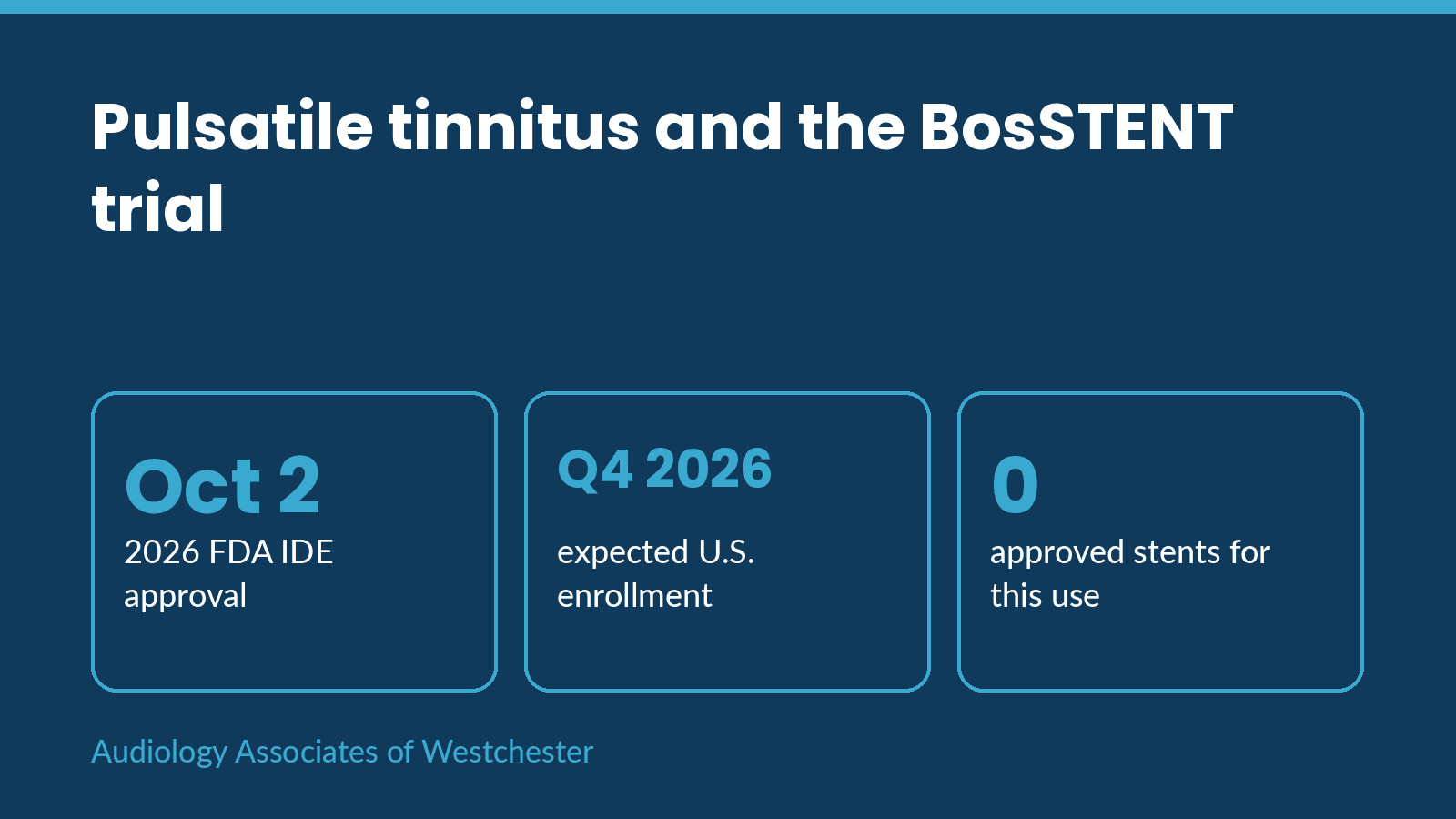
A sound that thumps along with your heartbeat is not the same problem as steady ringing. Sonorous Neurovascular's BosSTENT received an FDA Investigational Device Exemption on October 2, 2026, allowing B-SILENT 2, a U.S. pivotal trial, to go ahead. Sonorous expects U.S. patients to start enrolling in the last quarter of 2026.
The stent is investigational. It is not approved, and no practice can offer it outside a trial. We do not offer it or refer for it. Below: what the news means, what it leaves out and why the medical workup comes before anything else. It also keeps pulsatile tinnitus apart from the ordinary kind, because the two need different care.
“If you hear your heartbeat in your ear, a medical workup comes first.”
What the company announced
Per Sonorous, the BosSTENT is a braided mesh stent that expands by itself, designed for the cerebral venous sinuses, the big veins carrying blood out of the brain. It is meant for pulsatile tinnitus caused by symptomatic venous sinus stenosis, a narrowing of those veins. It describes B-SILENT 2 as the first IDE trial of its kind for a venous sinus stent in pulsatile tinnitus. The FDA gave BosSTENT a Breakthrough Device Designation in February 2026. An earlier study, B-SILENT, is recruiting in France and Canada toward a European CE Mark. A Breakthrough designation and an IDE are steps toward a review. They are not an approval.
Timeline of the BosSTENT program
The table lists each step with its date and what it does and does not mean. Read the last column first. It is where headlines mislead.
| Date | Step | What it does not mean |
|---|---|---|
| February 2026 | FDA Breakthrough Device Designation | That the device works or is cleared. It speeds review |
| April 2026 | FDA 510(k) clearance of the BosCATH delivery catheter | That the stent is cleared. The catheter is a separate device |
| Aug to Sept 2026 | B-SILENT enrollment begins at Canadian sites | U.S. availability |
| October 2, 2026 | FDA approves the IDE for B-SILENT 2 | Approval for sale. It allows the trial to start |
| Q4 2026 (expected) | U.S. enrollment expected to begin, per Sonorous | That enrollment has begun. We could not confirm it |
Pulsatile tinnitus versus ordinary tinnitus
Ordinary tinnitus is a ring, buzz or hiss that comes from the hearing system. Pulsatile tinnitus is a rhythmic whoosh or thump synchronized with the pulse, often tied to blood flow close to the ear. One cause is venous sinus stenosis, which Sonorous calls the most frequent. Arterial conditions and other problems can also cause it. Read more on our page about pulsatile tinnitus and the heartbeat sound.
Why a medical workup comes first
A pulse-timed sound may point to a vessel problem, which is why doctors examine it, frequently with imaging. A sudden start, one affected ear, dizziness, headaches or changes in vision raise the urgency. A hearing test still helps by documenting your hearing for the doctor. We test hearing. We do not diagnose the cause of a pulsing sound.
Where Lenire, sound therapy and hearing aids fit
Lenire is not for pulsatile tinnitus. Our Lenire candidacy guide lists who it suits and who needs a medical review first. Sound therapy and amplification target the ordinary kind. French researchers reported in 2026 that sound therapy delivered through hearing aids eased tinnitus distress when hearing loss was mild. Our page on the sound therapy trial has the details. It does not address the cause of a pulse-synchronous sound. See our page on tinnitus management, and on how to choose a tinnitus specialist.
A note for patients
Hearing your pulse in your ear? Do not wait and do not experiment on your own. See a physician first, and let a hearing evaluation run alongside. Ordinary tinnitus, by contrast, has plenty of help on offer.
What to do next
Book a hearing evaluation at our Harrison or Somers office, or call (914) 949-0034. Say so at booking if the sound pulses, and we will direct you to the right medical review. Leave your email in the box below if you want one note when U.S. enrollment begins.
Status and last update
Last updated October 28, 2026. Change note: this is the first version. We could not confirm that U.S. enrollment has begun. We will update this page when the company reports it. Sources are listed at the end of this page.
Medical information notice
This article summarizes published research and trial news for general education. It offers no medical advice, diagnosis or treatment. The BosSTENT is investigational and not approved. Pulsatile tinnitus needs a medical evaluation. Call (914) 949-0034 to book at our Harrison or Somers office.
Common questions
Is the BosSTENT approved by the FDA?
No. It remains investigational. An IDE lets the company run the U.S. pivotal trial, and the Breakthrough designation speeds review. Neither allows sale.
Can I get a stent for pulsatile tinnitus now?
Not with this device outside a study. Stenting is a specialist's call after a workup, and we neither offer it nor refer for it.
How do I know if my tinnitus is pulsatile?
It beats in time with your pulse. If you are unsure, tell a doctor and your audiologist. Pulsatile tinnitus needs a medical evaluation.
Can Lenire help pulsatile tinnitus?
No. Lenire is not for pulsatile tinnitus. A medical workup comes first.
When will U.S. enrollment begin?
The company's target is the final quarter of 2026. We have not been able to confirm a start and will update this page when we do.
Does the sound therapy trial apply to pulsatile tinnitus?
No. That trial studied ordinary tinnitus with mild hearing loss. It says nothing about a pulse-synchronous sound.
Want to hear when U.S. enrollment opens?
One email when there is news on B-SILENT 2, and nothing besides.